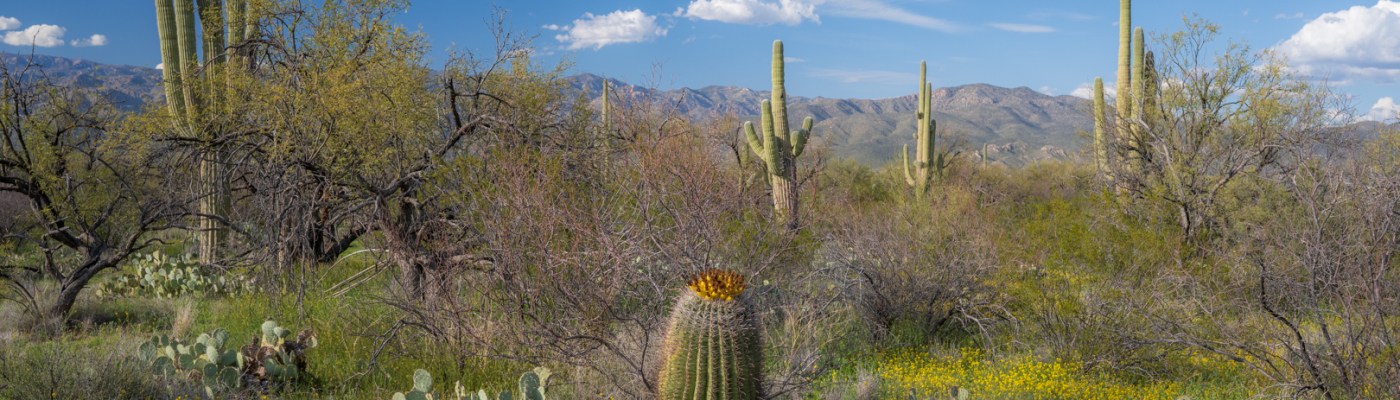
The next leg of my spring hiking trip had me at Saguaro National Park near Tucson Arizona. Saguaro National Park is divided into two units, the East and the West with the city of Tucson in between. Both units of the park boast miles of hiking trails through mountains and cactus forests so I was really looking forward to this park. Also, I tried to time this trip for the spring wildflower bloom which comes late March to early April. The saguaros don’t bloom until later in the spring, so I would miss that, but I do love wildflowers in the desert.
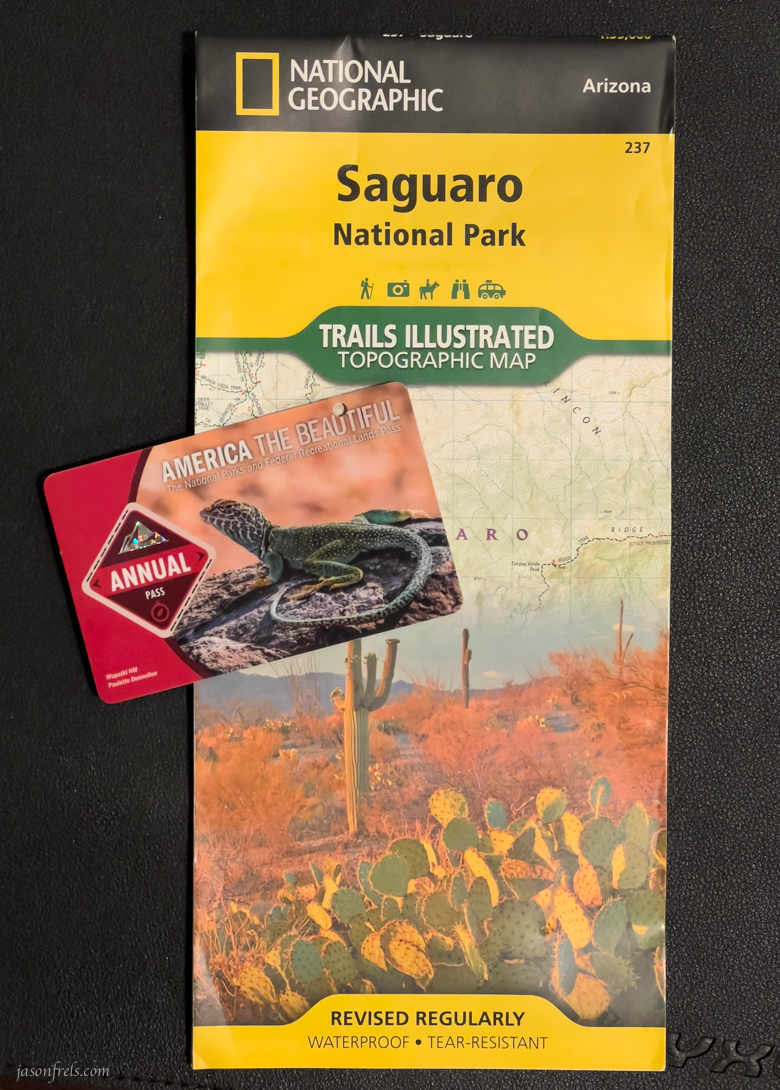
Many of the major trails in the East unit are very long and meant for multi-day backpack adventures with camps and springs up in the mountains. I wasn’t set up for any of that so I focused on trails that I could hike in day-visits. Also, many of the trailheads are accessed from outside of the park on public roads and there was no way I was going to hit most of these trails on my short 3-day visit. For the East unit I focuses on the Cactus Forest trail that runs across the main road loop and then I also hiked out on the Squeeze Pen – Carrillo trail. My plan was to enjoy the hiking and look for some good locations to shoot during the golden hour.
The image below shows a large saguaro along the trail. My understanding is that they don’t even start growing branches until they are at least 50 years old and can live more than 150 years and reach 30 feet in height. So, I am guessing the cactus in the image below is probably pushing 100. I think it looks good for its age.
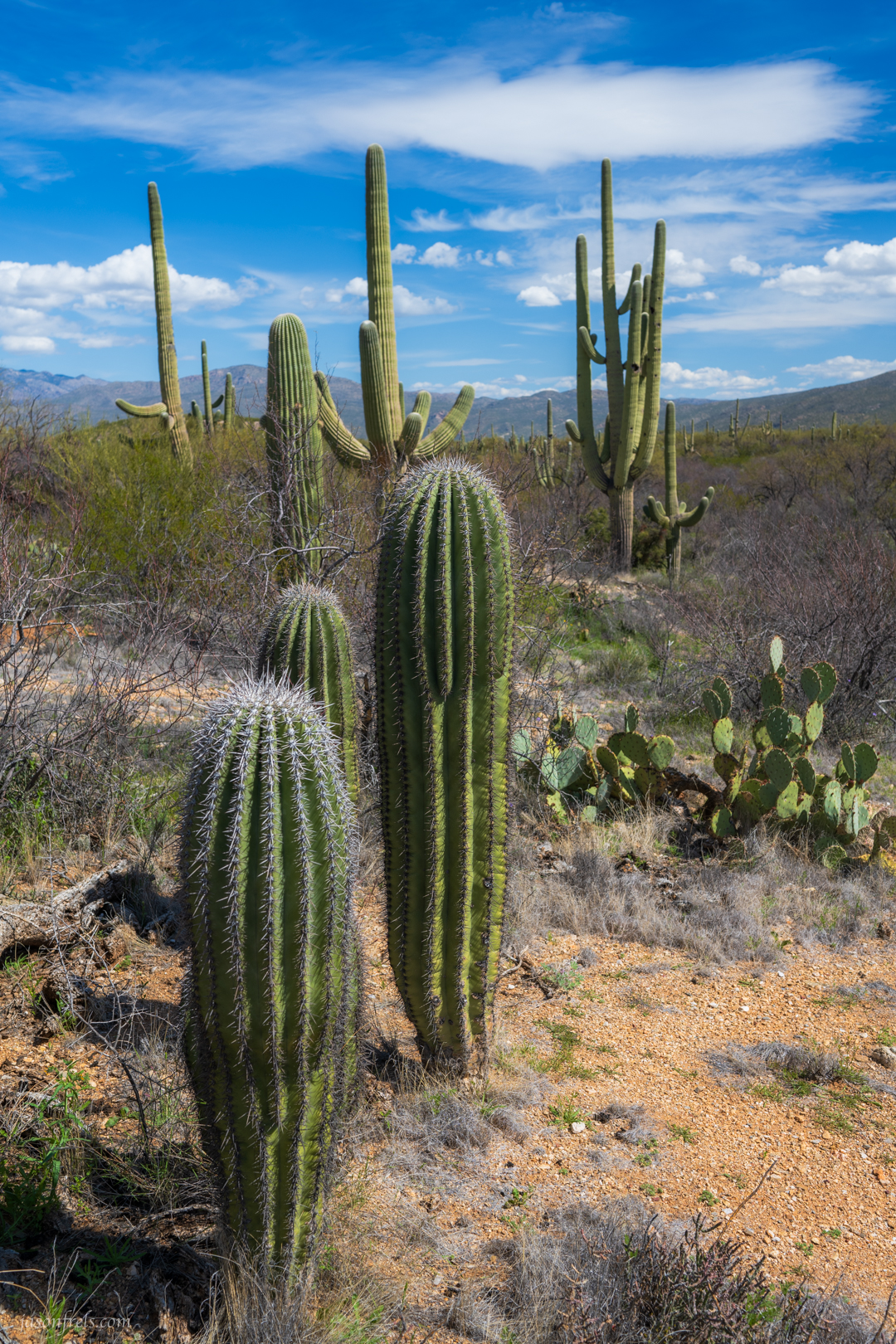
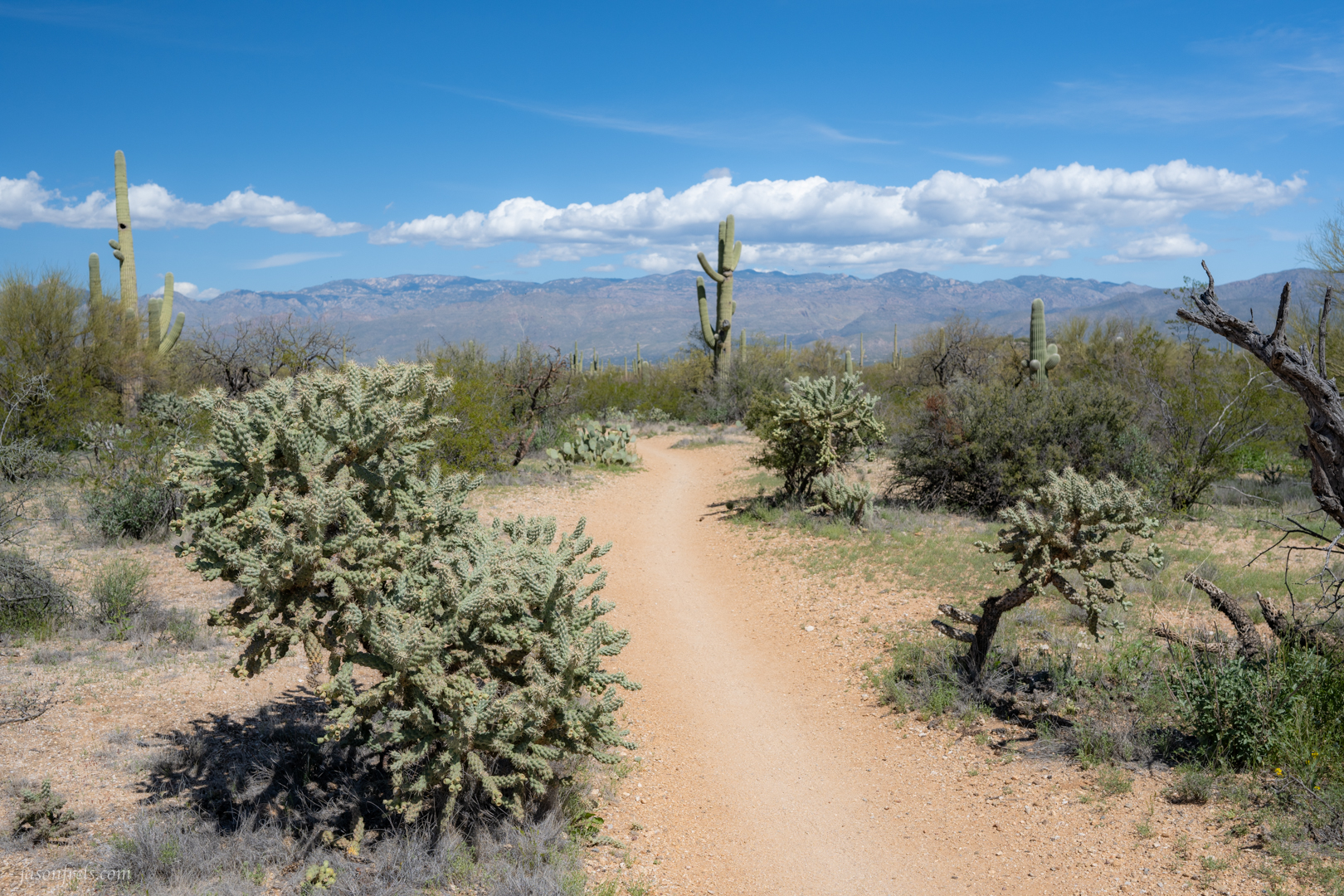
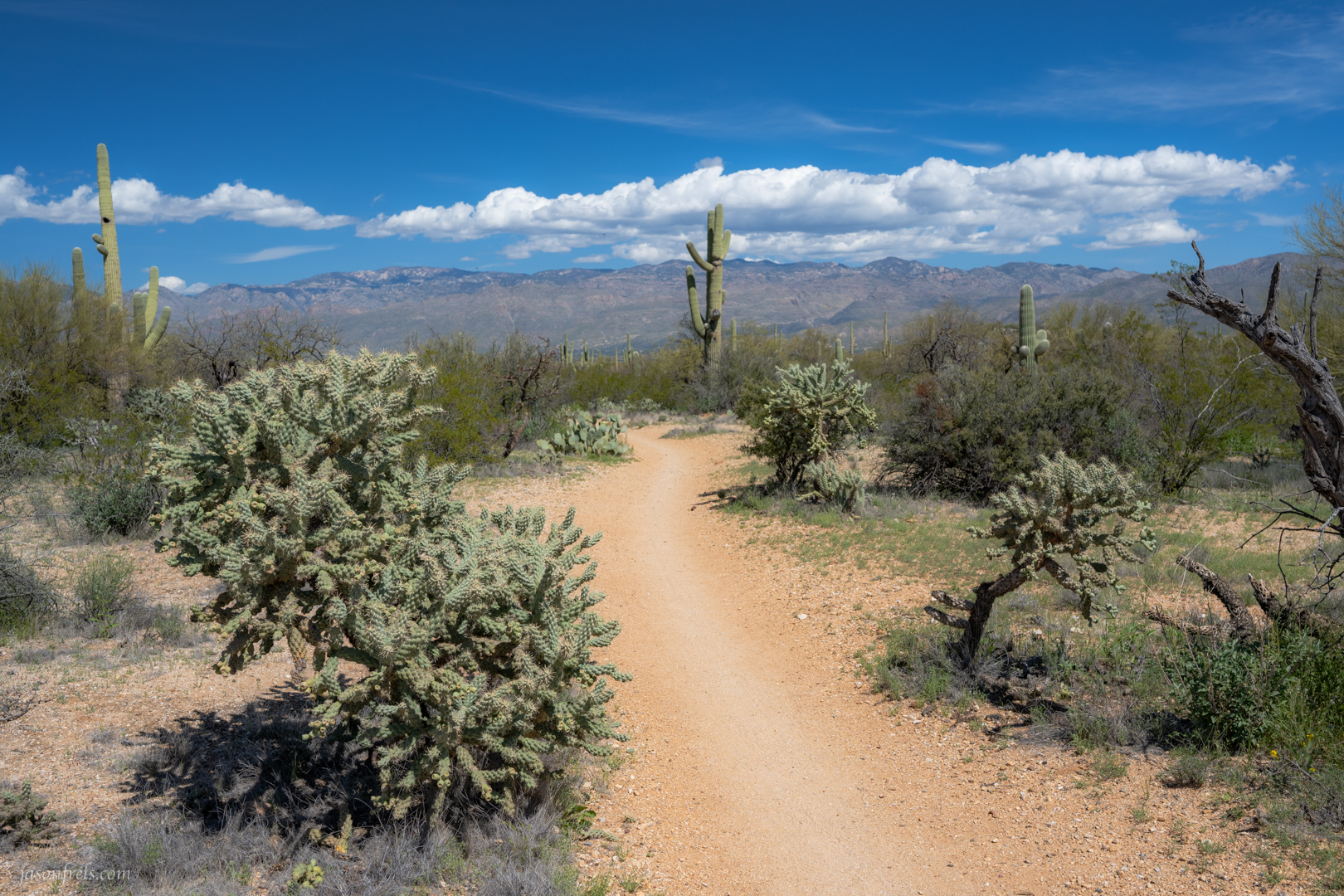
Sometimes when photographing a cactus scene, I would find multiple cactuses and wonder which I should focus on. One thing to consider is that the closer to the camera you focus, the shallower the depth of field will be. In the image below there are two cactuses close to the camera. The first cactus is about 2 meters from the camera and if I focused on it, the depth of field shot at f/7.1 is about 3.5 meters. But the second cactus is about 3 meters from the camera and the depth of field is over 8m for the same aperture. So, you can probably get both cactuses mostly in focus by focusing on the second cactus. In the image below I focused on the second cactus from the camera, and the first cactus is not perfectly in focus but it is close enough that you can’t tell without really looking closely. If the cactuses were much farther apart, you’d probably want to focus on the one closest to the camera as that is where the viewers eye will go first. Another option would be to take images at different focus points and combine them in Photoshop.
Many of my photos were shot during the midday light which results in a lot of glare, so I often shot with a circular polarizer attached to knock down the glare and hopefully bring out more color. The polarizer also can reduce how much distant haze shows up in an image and makes the sky bluer. In the images below the left image is with no polarization and the right image is with full polarization. Both files have identical edits applied in Lightroom. I think the polarized image looks much less washed out and has better color with the glare reduced. What do you think?
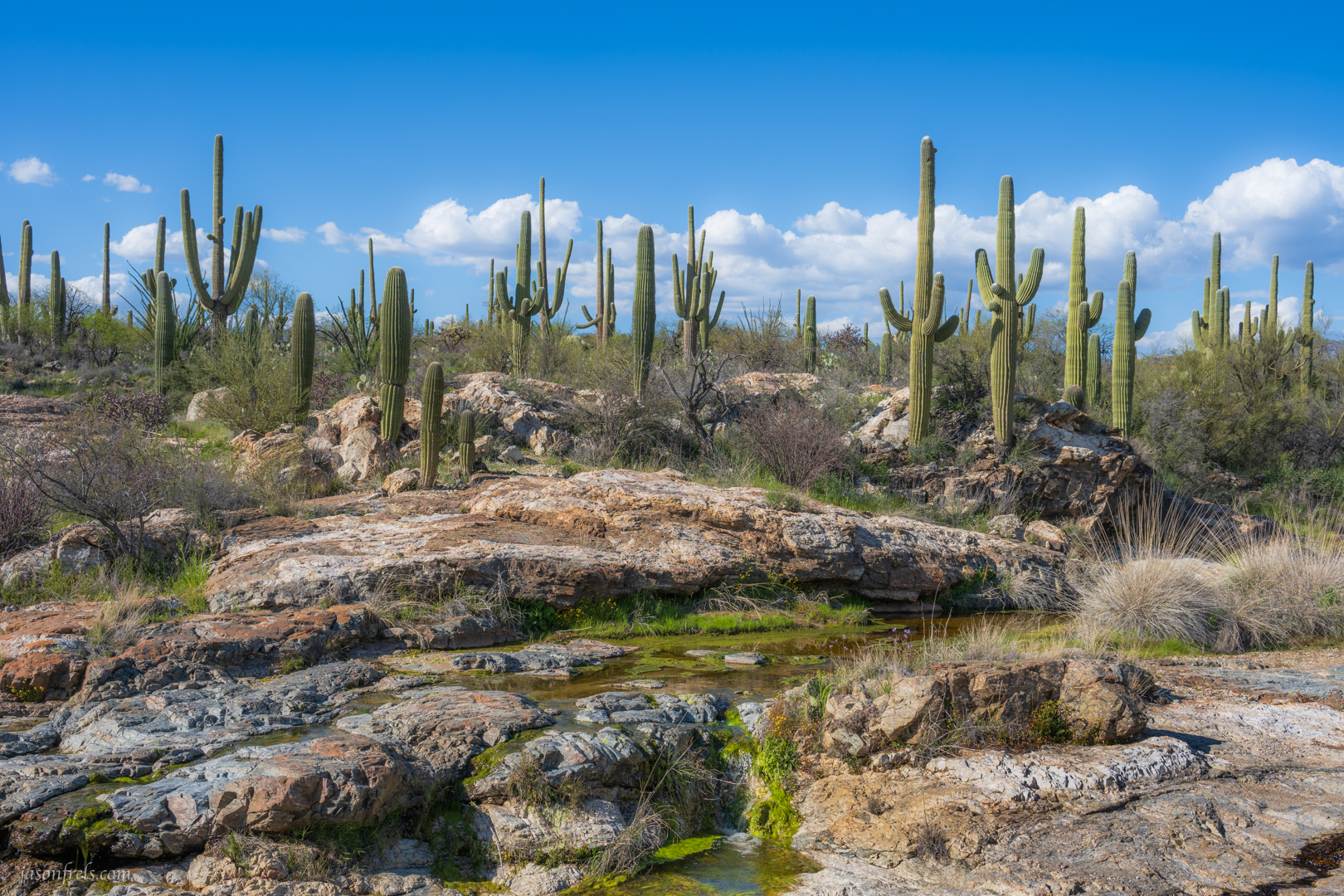
Up the Carrillo trail or Deer Valley trail, not sure, I came across a flowing stream with a small waterfall in front of a stand of saguaros. I got down low tried to make the waterfall a focal point but it really doesn’t show up very well against the rocks. I do still really like the scene but I would have loved to have gotten more water in the stream.
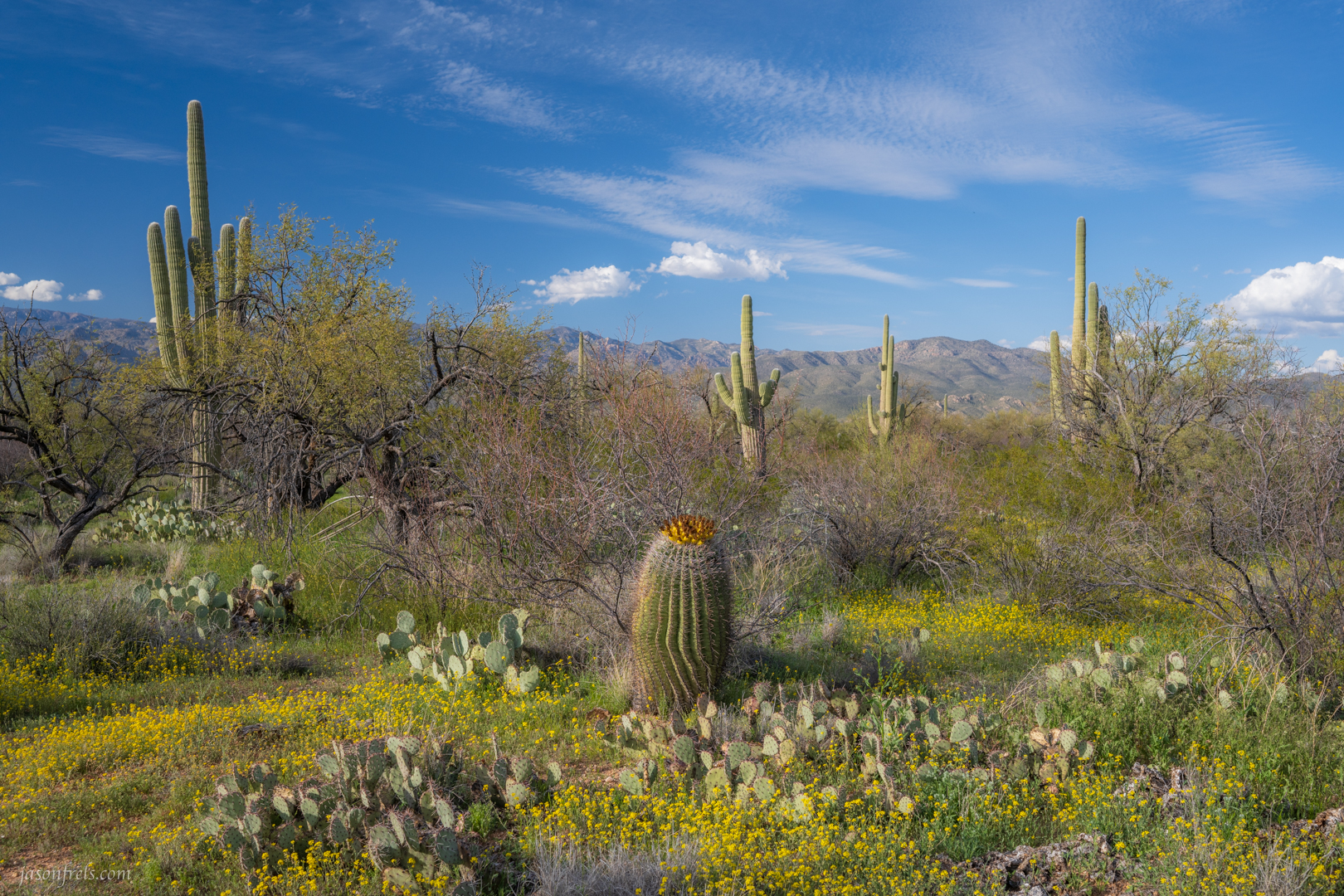
As the golden hour approached, I returned to parts of the trail where there were many yellow wildflowers among the cactuses. The image below shows three kinds of cactus, including a blooming barrel cactus, among the yellow wildflowers. I used the polarizer on this shot as well, and you may be able to see the issue with using a polarizer when the sun begins to get lower in the sky. The sky 90 degrees to the sun is a bit darker than the sky opposite the sun and it makes the image a little off. I didn’t really notice this while shooting.
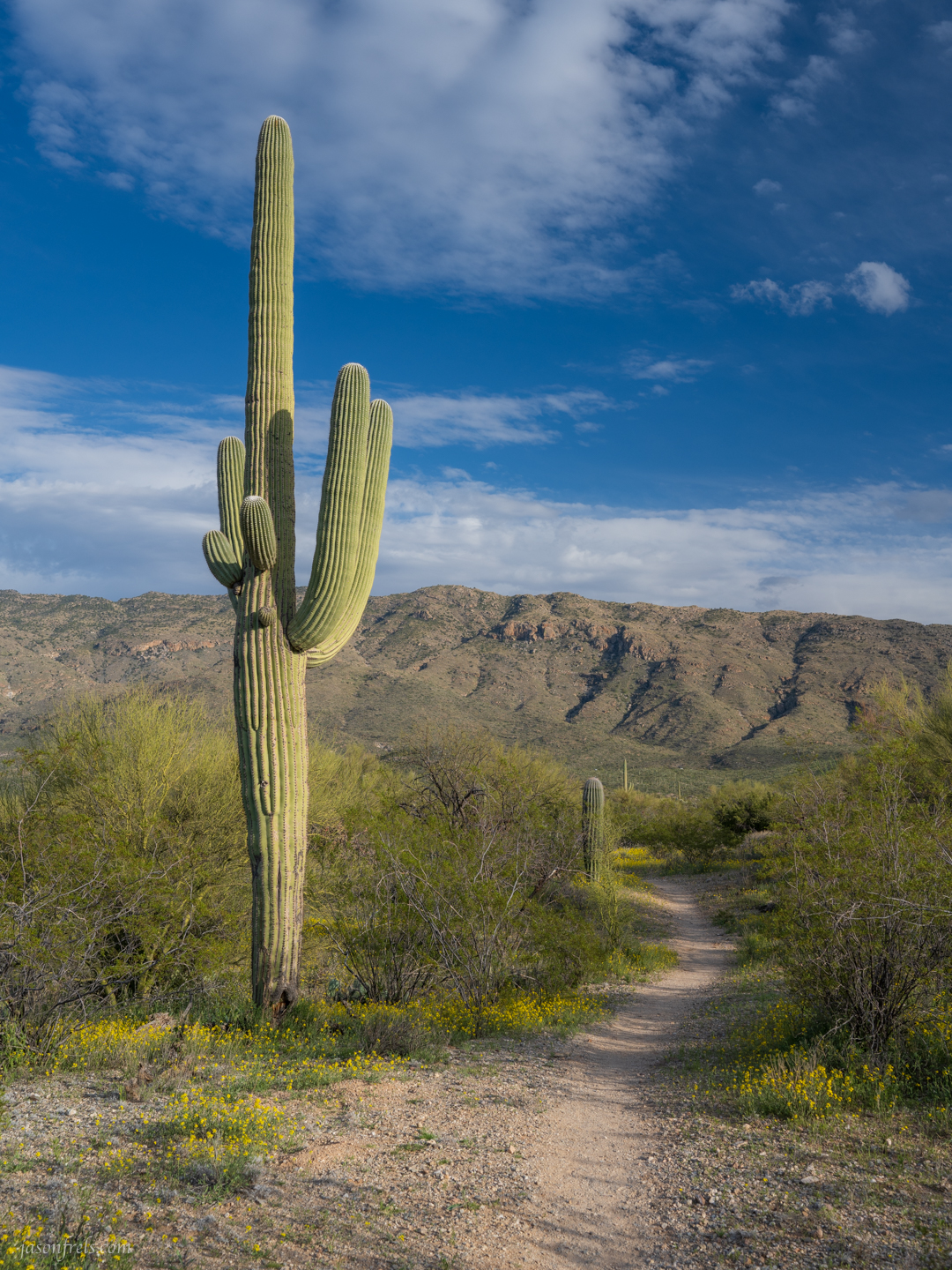
As the sun sank toward the horizon and the light grew more golden, I wandered around the trails looking for just the right setting of cactus and wildflowers. It was really hard to find a cactus that I could separate from the brush with a nice background. I believe the photo below is the best of my efforts – a very handsome saguaro catching the evening side-light with only a few minor branches of the tree bothering me.

I had planned this to be my easy hiking day as most of the trails I hiked here were flat. The next day at the West unit would involve a lot more climbing. I’ll have that in my next post. Thanks for reading and I hope you enjoyed the saguaros.
 Jason Frels
Great photos. I love Saguaro cacti. Unfortunately, they only grow east of the Colorado River. They’re plentiful in Arizona, but as soon as you cross the river into California there are no more Saguaro, for some strange reason.
I once had a camera where I shot with a polarizer in order to reduce haze and darken the sky. But I don’t like how unnaturally dark blue the sky can appear, so I don’t use a polarizer anymore. I think a hazy photo can look more natural, so I don’t mind it just as long as the photo doesn’t get too washed out.
LikeLiked by 2 people
They don’t get east to the Chihauhuan desert either. Arizona must have some conspiracy to keep them there.
I suppose I could take a polarized shot for the landscape and a non polarized shot for the sky and combine them in Photoshop.
LikeLiked by 2 people
That Photoshop seems like a real handy software program. If I ever get serious about photography again, I think I’ll have to get Photoshop.
LikeLiked by 1 person
Imagine you want to do one simple thing but there are 500 knobs and buttons with poor or no labeling, but none of them do what you want because you don’t know the secret keyboard shortcut. That is the joy of Photoshop.
LikeLiked by 1 person
Yikes. I think I’ll leave the Photoshop work to you.
LikeLiked by 1 person
I only use Photoshop when I absolutely have to. Lightroom is easy to use, very intuitive, and sufficient for nearly all of my editing. Photoshop is really good at making unwanted things disappear though, and combining multiple images.
LikeLiked by 1 person
Great post! I love it because we were just at Saguaro National Park last weekend. I still need to dump my photos and hope I got some good ones. I adore your polarized shot of the hiking trail…love that leading line among the cacti. I’m kicking myself for failing to capture something similar. Thanks for sharing these!
LikeLiked by 1 person
We might have passed each other on the trails. I was the tall dude carrying far too much camera gear.
LikeLiked by 2 people
I like the last three, all for different reasons. Maybe a living-in-the-forest thing, but I always picture a Saguaro laying across someone’s crushed car. South of here, in the high desert, it’s Joshua Trees that fill that slow-growing, larger flora niche.
I simply leave the polarizer on my camera. You can always dial down the effect; but I find that it can reveal things. Really thin clouds that form over summits or ridges are sometimes difficult even to see with a naked eye.
LikeLiked by 2 people
I am tempted to always leave the polarizer on but it is a bit delicate and not as well protected as the front element on the lens and more prone to scratches. The polarizer for one of my lenses has a big scratch on it that does show up in some photos.
Also, in some circumstances you can get a lot of flare even with a good quality polarizer. I do try to keep it handy though.
I did see a couple of old saguaros that had fallen over. I’ll bet they made quite a thud when they hit the ground.
LikeLiked by 1 person
The desert sentinel…great photos.
LikeLiked by 1 person
Jason I believe you are taking the same trip I have planned for next month! The photos are great and your written copy is a big help in my planning!
LikeLiked by 1 person
I hope you get to see the saguaros bloom. That was the thing I missed out on.
I also wanted to go to Chiricahua, but ran out of time for that.
LikeLike
Always enjoy the beauty of the Saguaros. I like the polarized version better because of it being more vivid and you know I like blue skies.
But where is the cow that was peeking out from around the Saguaro? 😉
LikeLiked by 1 person
Right before I took the photo, she mooved.
LikeLiked by 1 person
“Haha!” How rude of her. I guess you should have been quicker .
LikeLiked by 1 person
Polarizers like any tool can be helpful, or not. I like using them when shooting in monochrome on blue sly days with clouds. No need for a red filter then.
LikeLiked by 1 person