As you might have read in my previous blog post, I went on a trip with my daughter to see the northern lights near Yellowknife Canada. I booked a 4 night stay in Yellowknife that would give us the opportunity to see the aurora on Sunday night through Wednesday night as I had no idea what conditions to expect. I booked a tour with a company on Sunday night hoping that they might show me some good places to go that I could drive out to later in the week if the opportunity arose. But it turned out Sunday night the sky was covered by thick clouds and I was able to arrange with the tour company to change to Monday evening. On Monday the sky began to clear as you can see in the photos of my previous blog post and I was pretty excited about the night sky. The aurora forecast called for a 90% chance of seeing the lights.
You can get an aurora forecast from a place like NOAA as shown below. The aurora mostly occur in a band 10 to 20 degrees from the Earths geomagnetic poles. And luckily for aurora viewers, the aurora tend to be pushed by the solar wind into an area on the night side of earth. And luckily for aurora viewers in Yellowknife, the northern geomagnetic pole is skewed a bit toward North America in relation to the Earth’s axial pole, occurring somewhere in Canada’s Arctic archipelago. This all means that there are some prime aurora borealis viewing areas in North America across parts of Alaska and Canada.

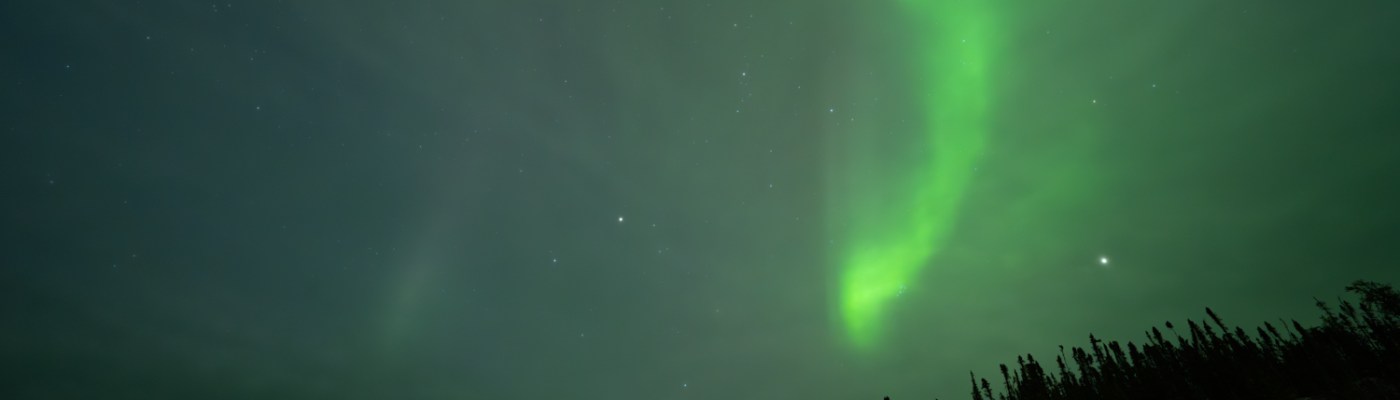
At about 10:00PM on Monday evening we went down and were picked up by the tour. It turns out that most of the tour business in Yellowknife is from visitors from East Asian countries as we were the only two westerners on the bus. I guess this makes sense as I doubt there are many people that want to go to northern Russia to see the aurora. Another North American option is Fairbanks Alaska, but I read that Yellowknife gave you better weather for viewing the northern lights this time of year. Anyway, the bus took us out along the road to the territorial parks I had visited during the day to a variety of stops. Most of these stops featured lakes, which is nice for the reflection potential. Below is one of the early shots I took with a ribbon of green light across the sky.

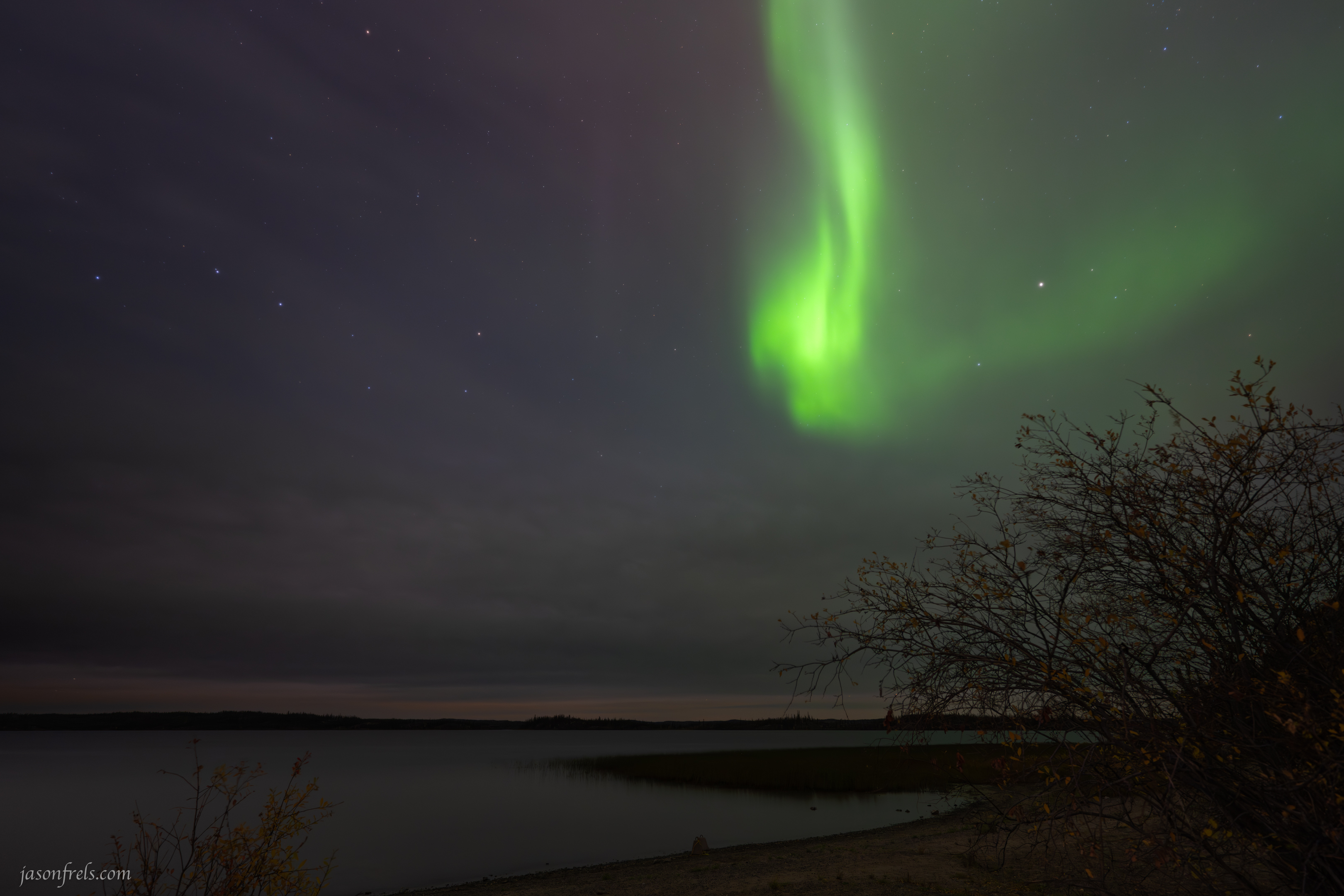
I didn’t really know what to expect from the viewing experience. I have lots of experience viewing the Milky Way in a dark sky site, and I know that I have to let my eyes adjust to the dark so that I can see the faint galaxy above. I thought that may be the aurora would be the same way, but it turns out the aurora are much brighter. When there was a strong band of light, it lit up the landscape in usually green light. The hard part was getting the camera set up before the light faded away. As to the camera settings, I didn’t need nearly as long an exposure or high and ISO as I would to shoot the Milky Way. I did pretty good with ISO1600 and about 13 seconds exposure with an f/2.8 aperture.
In the image below you can actually see color in the leaves and sand by the light of the aurora and only the brightest stars are visible. You can also see that we had some stubborn high clouds to get in the way of the stars. Look for the Big Dipper in the left of the image.
At one location, I stood with some boats in the foreground waiting for the sky to light up. I did get some light, but it was above some thin high clouds which obscured it quite a bit. But you can see a couple of bands of green light and some warmer light in the distance. Aurora are usually greenish in color but can also take on other colors depending on conditions, but mostly I saw green. The green light also lit up the boats along the shore in the foreground and made for a nice photo I think. Probably my favorite of the outing.

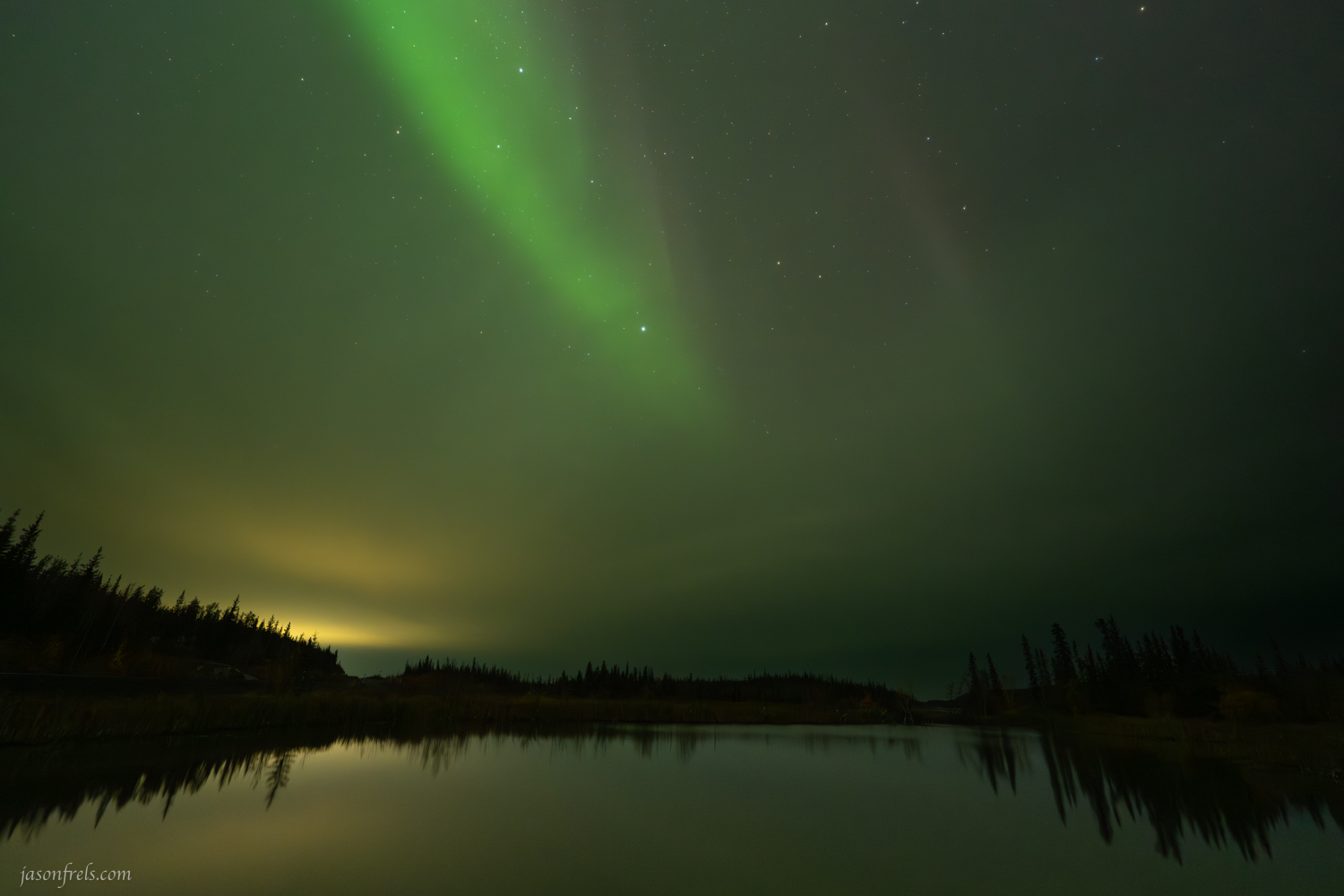
Later, at a different site, we had to wait through about an hour of inactivity even though the skies were clearer. Finally we got some bright green bands of light for a few minutes over the water. In the image below you can see the aurora high in the sky over the lake with lights from Yellowknife on the distant horizon in the lower left. I wanted to get the horizon more centered and get some reflection in the water, but the aurora were high in the sky, forcing me to tilt my camera up even shooting at 14mm.
I did see many beautiful places that I wanted to return to on the following nights, but Tuesday and Wednesday nights were thick with cloud cover and mist. So, I am thankful that at least one of my nights worked out so that my daughter and I could see the northern lights, something we had both been wanting to see. It is quite an experience and worth the trip I think. Thanks for reading.
You can also find me on Flickr
 Jason Frels
Great shots. With a 13-second exposure, I’ll bet you used a tripod. Northern lights seem very hard to capture with just a point-and-shoot camera. Now that I’ve seen your photos, I’m reminded that the aurora tends to be green, even though for some reason I remembered them as usually blue, in Iceland. Perhaps that’s how they were coming out in my Polaroid. Every photo with my Polaroid cost me $1.00 for the film, and this was back in the 80’s. So I wasted a lot of money trying to capture the northern lights with that damned camera. With the money I wasted, I think I could have bought a tripod.
LikeLiked by 2 people
I think they tend to be bluer closer to twilight when there is some sunlight in the high atmosphere, according to what I have read.
LikeLiked by 1 person
Maybe that’s what I’m remembering. Anyway, I like reading about this adventure you went on, and seeing the photos. It’s something to consider for the future, as my wife has said she’s always wanted to see the northern lights.
LikeLiked by 2 people
How does she feel about -30 degrees?
LikeLiked by 2 people
I don’t know. I’d probably wait to ask her after we got there.
LikeLiked by 2 people
In that case, you may want to book two hotel rooms.
LikeLiked by 3 people
Good advice.
LikeLiked by 2 people
They probably were “emerald blue.”
LikeLiked by 2 people
Where’s that head-smack emoji you often use?
LikeLiked by 1 person
😂
Sorry, it’s a secret. But glad to know you needed it. 😂 You just need to do it a few hundred more times now.
LikeLiked by 1 person
😄 Perhaps this is where your emerald blue skies came from.
LikeLiked by 2 people
Exactly! See, I did know what I was talking about. Jason probably has an “emerald blue” photo. He just isn’t showing it!
LikeLiked by 2 people
Yeah, I think Jason is hiding his emerald blue photos. Or maybe his Lightroom software manipulated the color.
LikeLiked by 2 people
Lightroom can only display colors that exist, so it is a problem.
LikeLiked by 2 people
Sounds like a bug, to me. They need to get some software engineers on this problem, and fix the code.
LikeLiked by 2 people
I am also unable to edit painfully cute images from Pinterest for some reason.
LikeLiked by 2 people
That’s awful. Those images give me indigestion.
LikeLiked by 1 person
Pfftttttt!
LikeLiked by 2 people
What a shame! 😛
LikeLiked by 1 person
I would be afraid to see what those adorably cute images would look like if you could edit them!
LikeLike
I agree! I bet the sky is emerald green whenever Betsy is around. Betsy is smarter than engineers, apparently.
LikeLiked by 2 people
Who do you think designed Betsy’s high-tech cowbell?
LikeLiked by 1 person
Hmmm…..Some intelligent engineer? Do you happen to know any? 😉
LikeLiked by 1 person
They don’t invite me to their special groups and events.
LikeLiked by 1 person
LOL! How sad. They probably feel intimidated by your intelligence.
LikeLiked by 1 person
Beautiful photos! I think the last one is my favorite. Too bad about the cloud cover the other nights, but I’m glad that you got at least one good night in! A fun experience to share with your daughter.
LikeLiked by 1 person
Thanks. I was a bit unsure about how I felt about the last one. Seemed a little unbalanced by the light in the horizon in the lower left.
I wanted the picture with the boats to be better but the high clouds thwarted me.
LikeLiked by 1 person
The light in the horizon is what made that photo stand out to me. I like the contrast between the Aurora and that, and of course the water.
Unfortunately, you can’t help the clouds, but I’m glad you took the boats photo, for it still is good!
LikeLiked by 1 person
Wow, what a great opportunity to see this phenomena. Fabulous photographic captures, too!
LikeLiked by 2 people
I like seeing the world as much as I can and I frankly don’t have much else interesting to do before I die.
LikeLiked by 2 people
The one with the boats is my favorite. Very pretty, thank you for sharing.
LikeLiked by 1 person
Nice pics, Jason. And the world is a big place for lots of potential sites to visit, so you will keep yourself busy before any eventual demise.
LikeLiked by 2 people
Beautiful pictures of the aura borealis! I can almost see them dancing through the sky! From where you were, I’ll bet you could almost reach out and touch them!
LikeLiked by 2 people
I’m not quite that tall.
LikeLiked by 2 people
😆 🤣
Nor am I…
LikeLike