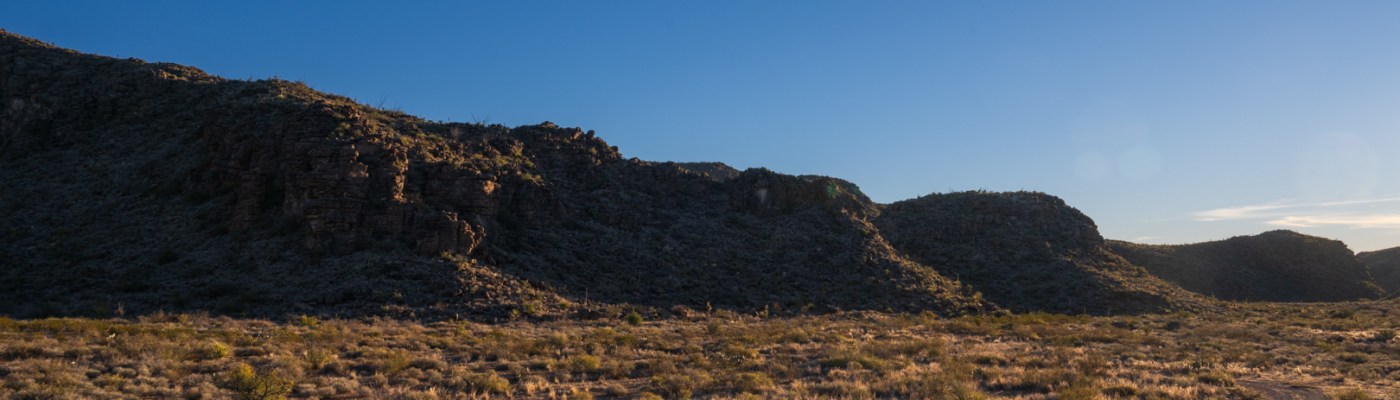
I have always wanted to go camping and hiking in the interior of Big Bend Ranch State Park in west Texas. Big Bend Ranch is the largest state park in Texas, and sits to the west of Big Bend National Park. The very southern part of the park is accessible via scenic SH 170 which runs along the Rio Grande, but the interior part of the park is remote and not so easy to access. From the Fort Leaton visitor center near Presidio, you have to take some dirt roads to get to park entrance and then from there it is another 25 or so miles to the visitor center in the center of the park. You can access these roads with most normal road cars and get to a few of the trailheads, but most of the park roads to the camping sites and trailheads require at least high clearance vehicles and often four-wheel drive vehicles.

Remote places like this are what I had in mind when I bought my little 4WD truck. I knew I would never be able to access some of the secluded place like this with a regular road car so this desire in part guided my buying decision. Now with everything I need in-hand and it being (nominally) winter, I reserved a remote and secluded campsite in the park in an area called Mexicano. To get to this campsite you must travel a road that requires a high-clearance 4WD vehicle, so I was excited that I would get to visit a place that had previously been unavailable to me. In many state parks, the campgrounds are all quite close together and it is difficult get away from the noise and activity of the other campers. This remote campsite out in the desert offers the solitude and quiet that I craved, and I got it!
Getting to the campsite was a bit of an adventure. After topping off my gasoline tank in Presidio and driving for an hour on dirt roads to get the visitor center in the center of the park, I then had to take a road that transitioned from maintained dirt road, leading to a very rough and rocky 4WD road. This part of the road went over loose rocks, down through dry creek beds, and over hills. I don’t think I ever got out first gear once on this road and it took me about an hour to get out to my campsite. A normal road-going car would have no chance of getting to this campsite.
A park employee had stopped me on the main road and advised me on this road and mentioned a rock climb with a 17% grade, but he seemed to think that I would be fine. Below is a phone photo showing the road leading up the climb and this was from the summit of another climb. The photo is shot into the sun, but you can see in the distance the climb up to the top of the ridge. It is not just the climb, but the rock surface is very uneven with pits and protrusions to navigate and at the top you are driving blind as all you can see is sky over the hood of the vehicle. When I got to these climbs, I stopped the truck, engaged 4-low, tried to pick a good path and proceeded up. The tires might have slid a few times, but I made it up without much drama.
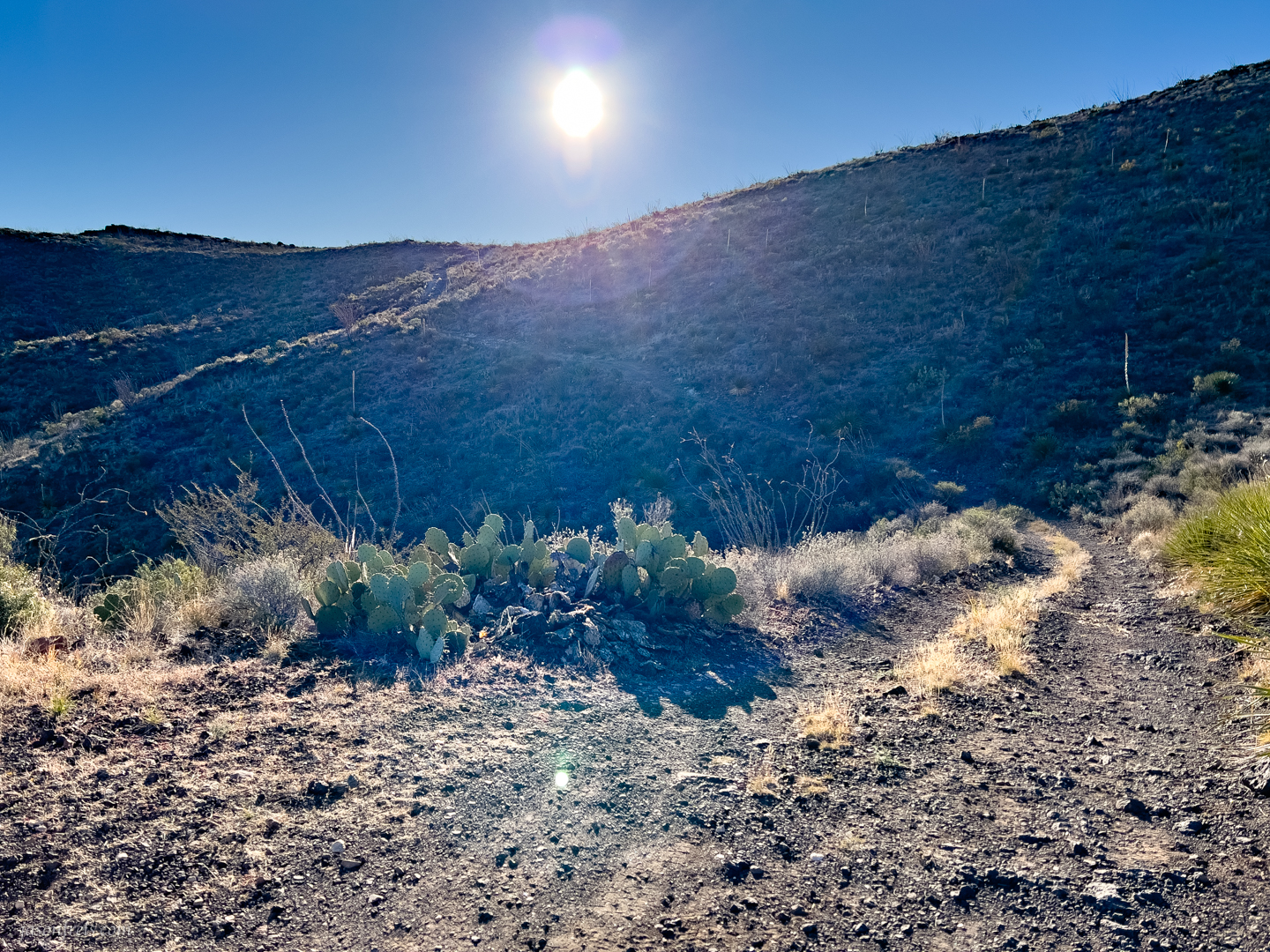
From there, the road continues to the campsites. You are also trying to navigate around the thorny shrubs that grow out toward the road. My main concern for the drive was the chance of tire damage. I have a spare, but I have no idea how I would change a tire out here. I have off-road tires, but they are only 6-ply tires that came with the truck. I will probably upgrade to 8 or 10 ply tires when these wear out. Anyway, I made it up the rocky desert road to the campsite and back down the next day with all of my tires intact. And fortunately I only passed one other vehicle the entire time and there was a convenient place to pull over to let them by.
The campsite was everything I had hoped for. It is well secluded between the cliffs and hills in desert wilderness. There is another campsite in this area but it is on the other side of a large hill from this one, at least 0.75 miles away as the crow flies. The campsite provides a picnic table, a fire pit and a place to pitch a tent or two. There is no water or toilet nearby, so you have to pack in your own water and are required to bring in a sanitary camping toilet which you can buy at the visitor’s center. At night there is no light pollution and the stars are as bright as they can be, though I had a full moon for this night to dominate the sky. Below is a photo I took of the campsite the following morning. There is an old stock tank nearby so I suppose this was a stock watering area when this was a ranch decades ago.

The night was calm and quiet and I didn’t hear a sound until an owl started hooting just before sunrise. The moon was bright enough that I could have read a book with its light. It wasn’t too cold, mid-thirties, and I was quite comfortable. In spite of finding the most perfect camping conditions I have ever experienced, I got almost no sleep that night. I lay wake staring at the tent roof for what seemed like hours. I don’t know what was wrong with my mind. I was so happy to be in this place of peaceful solitude, but I could not sleep. It made for a very exhausted following day.
Anyway, as the dawn approached I tried to take a few photos. I had arrived at the campsite in the evening twilight and had no chance to plan any photos for the following morning. I wandered around the nearby desert and tried different types of vegetation against the eastern sky. I think this cholla cactus works well enough as a foreground for the few colorful clouds on the dawn horizon over the hills in the distance.

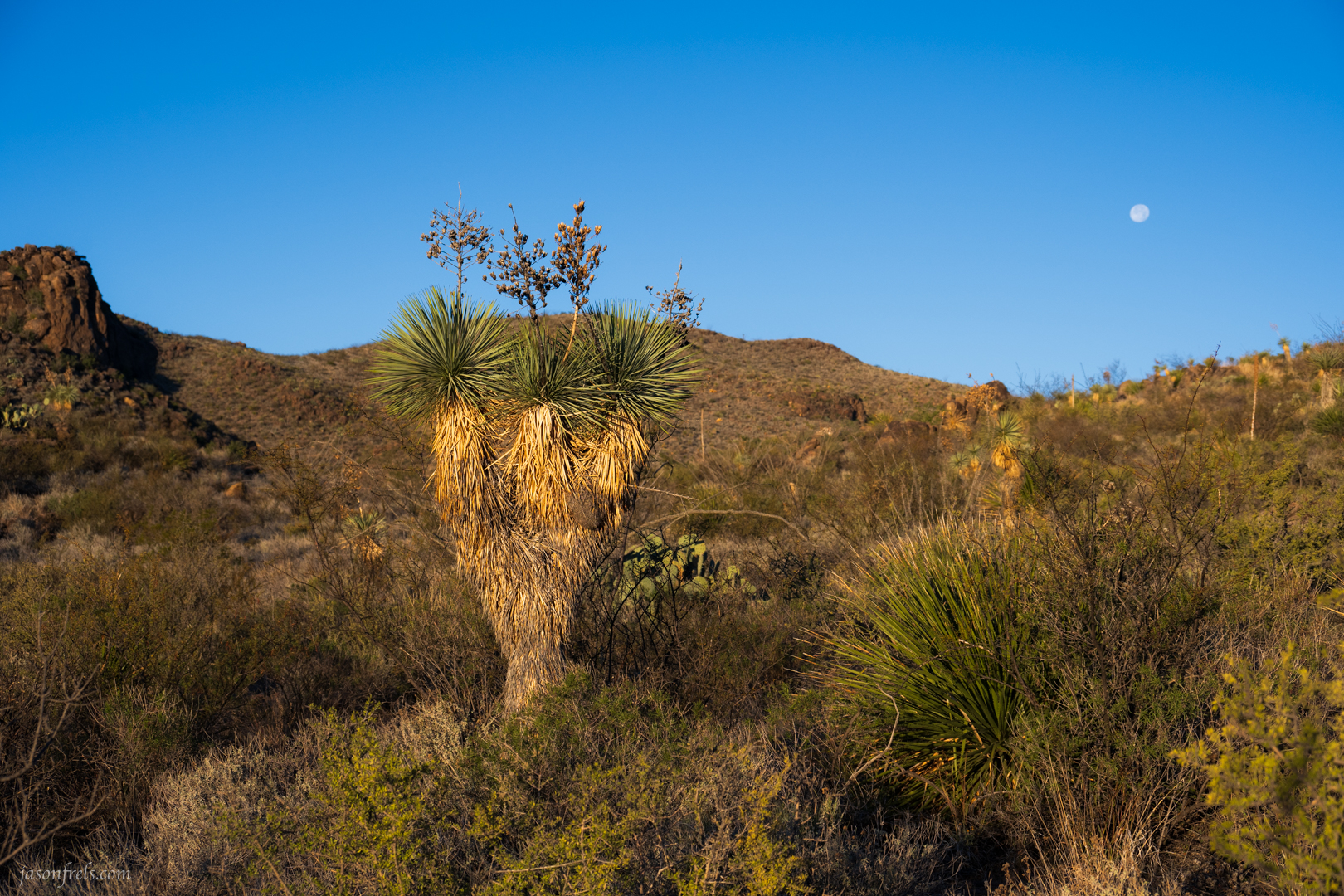
As the sun made it through the clouds and over the distant mountains, it lit up the area around the campsite and I messed around taking a few photos before packing up and heading for some hiking trails. You can see the morning sunlight off of a Sotol, Yucca, and the full moon in the photos below. There was a rocky outcropping near my campsite and I climbed around looking for things to photograph for an hour or so. These are a couple of the photos that I thought turned out nicely.

I did a couple of nice hikes that I will write about, but I was quite exhausted by the mid afternoon because of my lack of sleep. So I didn’t camp another night, but decided to head home which may not have been the best decision since it was an 8 hours drive, but I was so tired that I was done. I did get home safely at about 11:30 that night.
 Jason Frels
The views are stunning! The hill climb looks like one my uncle’s 1970s Land Rover would have handled with ease. Do you know the clearance required for an adventure like this? My wife’s 2023 Acura RDX has a ground clearance of 5.7 inches, or 14.5 centimetres. I doubt it could handle this road track.
LikeLike
A nice Christmas gift to yourself, getting to enjoy peace and solitud. Sorry it ended up being shorter than you had planned on, but glad you made it safely home!
Great photos of the plants against the pretty blue sky. Looking forward to hearing and seeing more of your adventure.
Are there wild animals in a remote place like that?
LikeLiked by 2 people
There had to be. I’m sure he ran across a few hoop snakes and jackalopes.
LikeLiked by 2 people
He may have found the secret hiding place of the jackalopes. I hope he got some photos of them.
LikeLiked by 2 people
Maybe it was the braying of the jackalopes that kept him awake all night.
LikeLiked by 1 person
More likely, the coyotes! Jackalopes are quiet. They don’t want to give away their hiding place.
LikeLiked by 2 people
I didn’t hear any coyotes. They must have been in a different part of the park. I also didn’t see any Chihuahuas even though I was in the Chihuahuan Desert
LikeLiked by 1 person
“Haha!”
LikeLike
Maybe I was thinking of the jackasses.
LikeLiked by 1 person
Yes, I think you got confused! It’s OK, go take your medicine and you will be alright.
LikeLiked by 2 people
I already took my medicine. Or did I? Maybe I’d better take it again, to be sure.
LikeLiked by 2 people
I think you are supposed to take it with coffee.
LikeLiked by 2 people
Black? With cream? Or loaded with sugar, caramel, and exotic flavorings, Carolyn style?
LikeLiked by 2 people
If you want cream a sugar, go have a dessert. I just want regular old hot black coffee.
LikeLiked by 2 people
Some of us like to drink our “dessert” 😋
LikeLiked by 1 person
My pancreas and I agree.
LikeLike
But your taste buds are mad at you!
LikeLiked by 1 person
They won’t stay mad for long. They’re my buds.
LikeLiked by 2 people
😂 smartie! 😶✋️!!
LikeLiked by 2 people
LOL! Very true!
LikeLike
Good idea!
LikeLiked by 1 person
I think so. So I’d better take it now. Or, wait? Didn’t I take it a few minutes ago?
LikeLiked by 1 person
Oh help!
LikeLiked by 1 person
I didn’t find any Pennsylvania animals out there.
LikeLiked by 1 person
Haha! Sad that you all don’t have the rare, special animals that Pennsylvania does.
LikeLiked by 1 person
So rare that you are probably the only person that “sees” them.
LikeLiked by 1 person
What can I say they are a good judge of character. 🤪
LikeLiked by 1 person
Either that or you stayed up too late working on one of your stories.
LikeLiked by 1 person
Haha! I think it’s obvious that you got plenty of sleep, Mr Witty , you could get a gold star for your wit today ….. if I gave gold stars for that, but sorry, I don’t. 🙂
LikeLiked by 1 person
I’m sure there are wild animals though I didn’t see a lot. The desert won’t support a high density of large animals, but the park is home to deer, big horn sheep, javelinas, mountain lions, black bears, and probably coyotes. I did see a large jack rabbit and I heard an owl.
LikeLiked by 1 person
Javelinas?
So you did see a jackalope but confused him with a jack rabbit, and you heard Odessa calling you.
LikeLiked by 1 person
I think I am beginning to understand why you smack you head so much.
LikeLiked by 1 person
Ahh! So you are realizing that its the fault of certain stooges? 😛
LikeLike
Campsites like that are a good reason to have a high-clearance 4WD pickup. Too bad you didn’t get any sleep, as it can be hard to feel motivated to hike when the brain wants to recharge itself. Great photos.
LikeLiked by 2 people
I will probably go out there again some day and try again. That was my first time in the interior of the park and now that I have seen and experienced a few things, I think I can make better plans. For instance, I left home at 8:30AM and didn’t get to my campsite until after sunset, mainly because I didn’t realize how long it would take to drive into the park from Presidio. I did stop at a nice diner in Alpine for a late lunch.
LikeLiked by 2 people
I’ve heard that getting to destinations late can happen in Texas, since it’s such a big state.
LikeLiked by 1 person
Did you get to see the owner of the diner? Did he have luxurious hair by any chance?
LikeLiked by 1 person
No, but I did get a job offer.
LikeLike
😂 riiight! Did they want you to wash dishes?
LikeLiked by 1 person
No, their waitress broke all of their dishes.
LikeLiked by 1 person
Hmmm….too bad that they don’t have a waitress like that superb one at Mason’s Diner.
LikeLiked by 1 person
Oh, I didn’t know Mason had hired a new waitress. Did I miss one of your stories?
LikeLiked by 1 person
Oooh…. 😶✋️! No, you didn’t miss a story, smart …!
LikeLiked by 1 person
This is a place that is on my bucket list Jason. Can’t wait to see what you have photographed on your hikes.
LikeLiked by 1 person
Thanks, I didn’t cover much of the interior of the park because the park is vast and the trails are long. But I went on a few hikes and then I took the scenic highway along the Rio Grande from Presidio to Lajitas on the way home. This adds a lot of time to the journey, but it really is a beautiful drive.
I am trying to figure out how it might make sense to be out there for Milky Way photography in the summer months. I definitely wouldn’t want to do too much in the heat of the day out there in the summer.
LikeLike
Nice truck. But no charger at the campsite? And yes, jacking on a rutted double-track is a PITA.
During a solo night, there comes a point where one just has to accept the possibility of being eaten by a bear or buried in snow until spring. A little wine and a pair of earplugs help. But during a full moon, especially in winter, it can be interesting to travel at night.
Perhaps just the absence of wild horses (or cattle), but the area reminds me a little of Joshua Tree National Monument.
LikeLiked by 2 people
“The possibility of being eaten by a bear….” Yeah, that would be enough to keep me awake. LOL! Guess that’s why I am not as adventurous in the woods. There aren’t bears at beaches. 😉
LikeLiked by 2 people
No, just sharks.
LikeLiked by 2 people
I don’t go out deep enough to be worried about sharks. And I have never seen one wash up on shore, so I am safe.
LikeLiked by 1 person
Charger? It’s a long way to electricity from there. I have a little Jackery battery pack that can easily keep everything I have all charged up.
There is very little chance of being buried in snow at this park. When I was in Big Bend National Park last January, it snowed at the camp ground up in the mountainous part of the park, but it was less than an inch. It is a desert in the cold weather as well as the hot weather.
I would be more worried about the mountain lions than the black bears. But I have yet to see a mountain lion out in this area. I think if you just take care of your food, you probably don’t have to worry about black bears or javelinas coming round. If it was summer, I’d be more worried about rattlesnakes as well.
LikeLiked by 1 person
Apologies for the inaccessible fun-poking per my article from last October. I just carry a 20-liter NATO can for the truck, and a couple of DeWalt tool batteries with a USB adapter. My Tacoma is the previous generation, and presently shod in studded 10-ply. The summer tires are better adapted to negotiating desert rocks.
My solos are usually mountain hike-ins. The local bears are really only food nuisances, and I’ve never actually seen a mountain lion (which I suppose could be good or bad). Snow is just a fact of life here, including in the high desert to the east where the valleys are over 4,000′ and the back-road passes crest 7,000′. Rattlesnakes and scorpions in your boots… desert things, though mostly in the summers.
LikeLike
Well, Texas is not know for heavy snow cover so it isn’t something I worry about. If it does snow, it doesn’t much stick around. I do have this vision of one day shooting the desert in the snow, but I don’t know if that will ever happen.
The little Jackery that I have has kept my camera batteries charged for a days without an issue. I got it on sale a couple of years ago and it is nice to have. You can buy much larger ones and power an entire campground full of stuff that you should’ve left at home if you like. When I camp, I don’t want the luxuries of home; just the peace and solitude of nature. The only problem with the Jackery is that you cannot bring it on an airplane.
The scariest animal to me out there is a rattlesnake. I keep my tent zipped up with the zippers meeting at the top for fear that they might find a way into my tent to keep warm. I also wear ankle high boots and am careful to listen for them. They are nice enough to make a lot of noise when you get too close. They aren’t attracted to my food, but their prey might be and I keep my food stored in a safe place and not in my tent. In the winter, they aren’t much of a problem.
LikeLiked by 1 person
Looks like a nice adventure Jason. And a good excuse to buy a truck with 4-wheel drive so one can visit such parks. And I do believe there are such things as solar powered chargers. Texas has plenty of sunshine, so there should be endless opportunity to keep it charged and usable to recharge other items, yes.
LikeLike