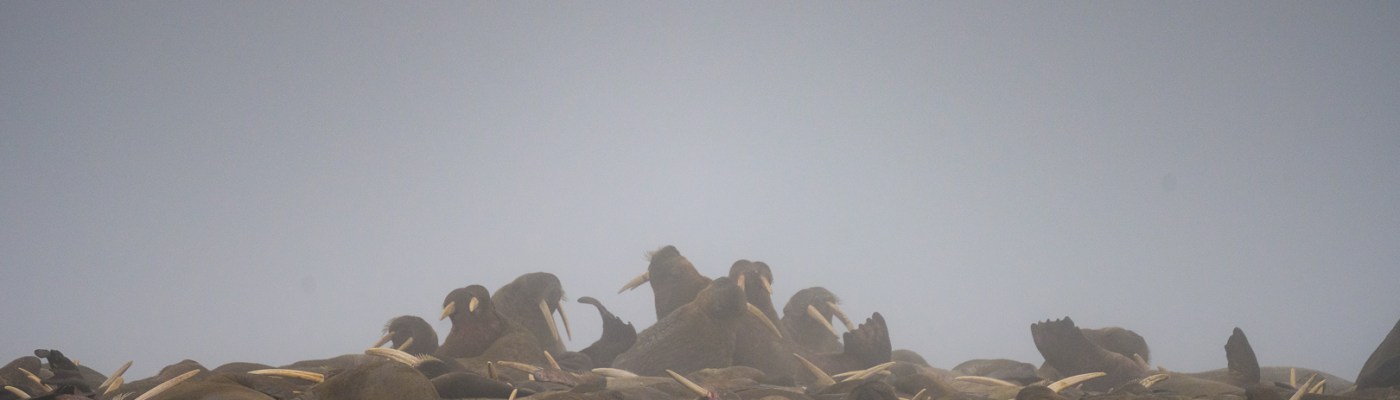
In addition to polar bears, another large mammal that is common to Svalbard is the walrus. I saw walruses multiple times on my trip, but the most significant time was when we took a zodiac ride close to the shore of a small island where a large herd was hanging out. This was a mornings in which the expedition was fighting some stubborn fog that had moved in. This limited our options for activities. We couldn’t go ashore and hike because the scouts couldn’t see whether or not there were polar bears. We couldn’t see the landscape for the fog. But we were able to get safely close enough to the walrus herd on the shore to observe them.

As I said, it was a foggy morning and as we rode the boats toward the shore we could generally smell them before we saw them. It turns out that a large herd of walruses laying on a beach is one of the smelliest things you can encounter. It smelled a lot like a stockyard, except quite a bit worse. But our sense of wonder and curiosity at seeing the wildlife mostly overcame our displeasure at their smell. The image below shows the odoriferous beach through the fog.

To avoid disturbing the walruses, the zodiacs kind of slowly cruised in a carousel formation near the beach, giving everyone a chance in the rotation to get a good look at the pile of walruses. It was difficult to really choose a good composition, at least for me, as it was very much dependent on what they were doing when I happened to pass by. Often there were one or two that were doing something such that you could almost get a shot focused on one. My main model, in the images below, was this large guy with the blotched face that was scooting around the beach.

These images were all shot through fog and a bit difficult to edit. In Lightroom, I generally tried to isolate the walrus or walruses with a mask and apply some dehaze and contrast. I also warmed their color up a little as the fog made them look gray. Though I did let the walruses in the background fade into the gray a bit to have a sense of depth. I think my edits were mostly subtle.

In addition to sitting around on the beach, there were often lots of walruses floating around in the shallow water which is what they are good at. They like to float in the shallow water where they can easily dive down and eat clams and such off the seabed. They seem to be well adapted and skilled at removing clams from their shells. I have read that they have also been known to eat seals.
Aside from people, there are really only two other animals they have to worry about. At sea they are vulnerable to orcas, which is their main predator. On land they can be vulnerable to polar bears, but they are generally too big and tough for a polar bear to handle without risking severe injury. The adults are far too big for a polar bear and have very think skin that the bear can’t easily penetrate. The polar bear’s only real hope is to stampede them and hope to pick up a young or injured walrus. This high risk attack is generally an act of desperation for a starving bear.
A couple of days later when the fog cleared, we found a herd of walruses happily floating just offshore of a beach that had four polar bears on it. The walruses didn’t seem to be worried and the bears expressed no interest in them as they wouldn’t have a chance in the water against a walrus. It did give me a chance to shoot them in sunlight. My main problem was getting them when their heads were far enough out of the water to get a good look at them, which just required a lot of bursts. And fortunately, when they are submerged you can’t much smell them.

After the foggy pictures we spent the rest of the day with not much to see but fog. We apparently traveled along the south coast of Nordaustlandet island, where there is reputedly a long giant glacier wall. But, this was the only real time that the weather didn’t cooperate so I have not much to complain about. Our next destination was Kvitoya, the White Island, which is the eastern most island in Svalbard and it would take until the next day to get there.


There’s something a little spooky about walruses in the fog. I’d hate to be taking a walk in the fog and suddenly find myself surrounded by these behemoth, bucktoothed creatures. But I’d probably smell them first. Great photos, once again.
LikeLiked by 5 people
You’d smell them. I’m told that if you get too close to them you risk gagging and throwing up from the smell.
The fog does simplify things a bit with the photos, but you really can’t get an environmental type shot with the fog.
LikeLiked by 1 person
Maybe walruses are something like kimchi. They smell awful but taste delicious.
LikeLiked by 1 person
Orcas seem to like them but sometimes they go after boats so what do they know.
LikeLiked by 2 people
I’ve heard that down in the Mediterranean Sea the orcas have been sinking boats. Maybe they’re getting tired of humans invading their turf.
LikeLiked by 2 people
Humans can be a real pain in the ass. Especially when they have boats.
LikeLiked by 1 person
I agree. I wonder who the no-good-for nothing lout was, who first floated the idea?
LikeLiked by 1 person
An ancient caveman named Tipsy Canoe.
LikeLiked by 3 people
LOL!
LikeLike
That name sounds familiar. I hope we’re not related.
LikeLiked by 1 person
Now that is pretty sweet. Did the guides say whether all walruses have the tusks? And did anyone start humming a Beatle’s tune by chance?
LikeLiked by 1 person
I don’t know if all walruses have tusks. I saw mostly smaller walruses without tusks, but I figured they might be juveniles. Someone did say “coo-coo-cachoo” at some point.
LikeLike
What remarkable creatures. Glad you were able to see them sans fog. They are fascinating creatures but I had no idea of their odiferousness.
LikeLiked by 2 people
That’s what they used to say to my mother when they met her four boys for the first time.
LikeLiked by 2 people
🤣
LikeLiked by 1 person
I am impressed with the foggy pictures. One can tell they are walruses and not just foggy blobs. Great job again!
Those tusks do look intimidating, plus their huge size. I would rather meet up with a baby seal on the beach.
LikeLiked by 2 people
Some of my best photos are the ones in which you can tell what it is in the photo. Thanks.
LikeLiked by 2 people
🤦♀️! LOL! Yes, it does help improve the picture when one can tell what it is, smartie!
LikeLiked by 1 person
I’m just in a bit of a mood this morning. You should pay less attention to me than usual.
LikeLiked by 1 person
No problem. Friday is almost here, if that helps, and i have a story coming later this morning.
LikeLiked by 1 person
I always look for them. Thursdays aren’t bad and summer is almost done.
LikeLiked by 1 person
Well, it may not be morning anymore, but I did post the story finally. My schedule is all out of whack.
LikeLiked by 1 person
I’ve been sitting here all day drinking coffee and waiting.
LikeLiked by 1 person
Oh gosh! Yeahhh, I am sure you have done nothing else while waiting. I hope it was worth the wait. 🙂
LikeLiked by 1 person