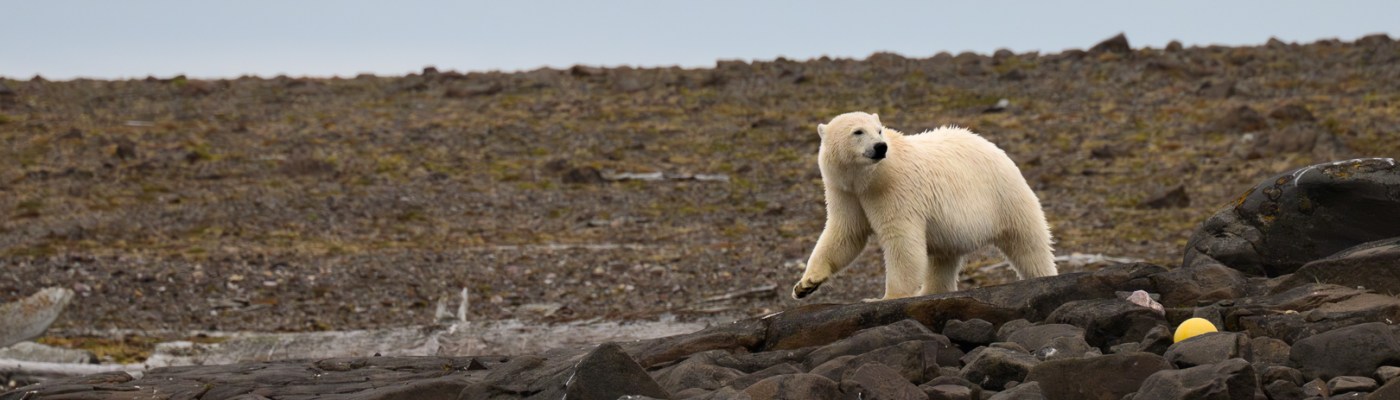
I saw polar bears on my trip to Svalbard. I saw a lot of polar bears. The archipelago crawls with polar bears. I am not an experienced wildlife photographer and my camera is not considered an excellent wildlife photography camera, but I will tell you about my experience and what I tried.
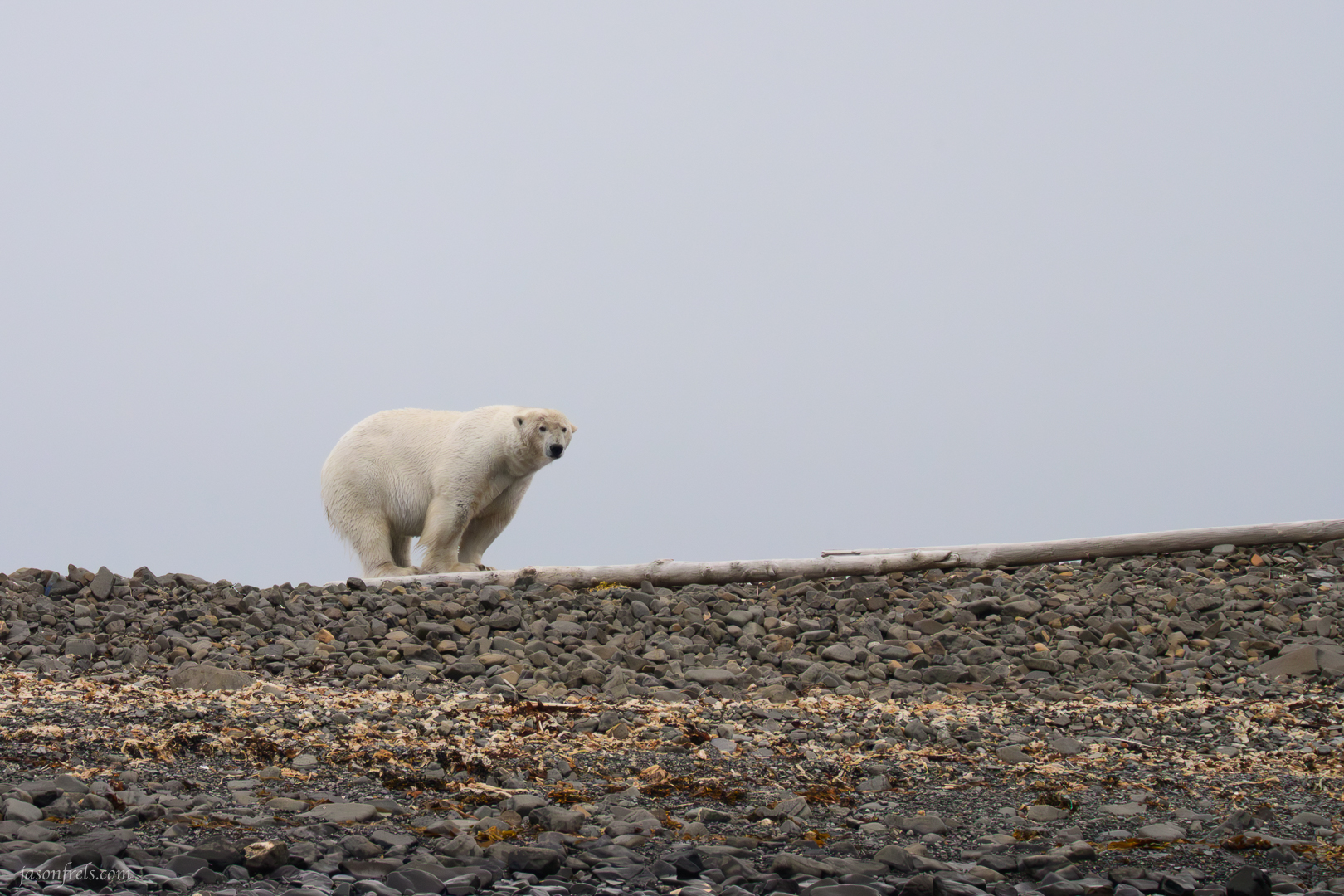
First, I want to say that I saw the polar bears from a safe distance on a zodiac floating offshore. All of my photos were shot with a telephoto lens and cropped. At no time did the expedition company put me or the polar bears in any danger. There were strict rules about how close we could get to a polar bear. The bears never reacted to our presence as far as I could tell. If the bear jumped in the water and started swimming we had to move away from the bear. So, now that you have been assured that the bears were safe and I was in no risk of being hors d’oeuvres for the bears, I’ll move on.
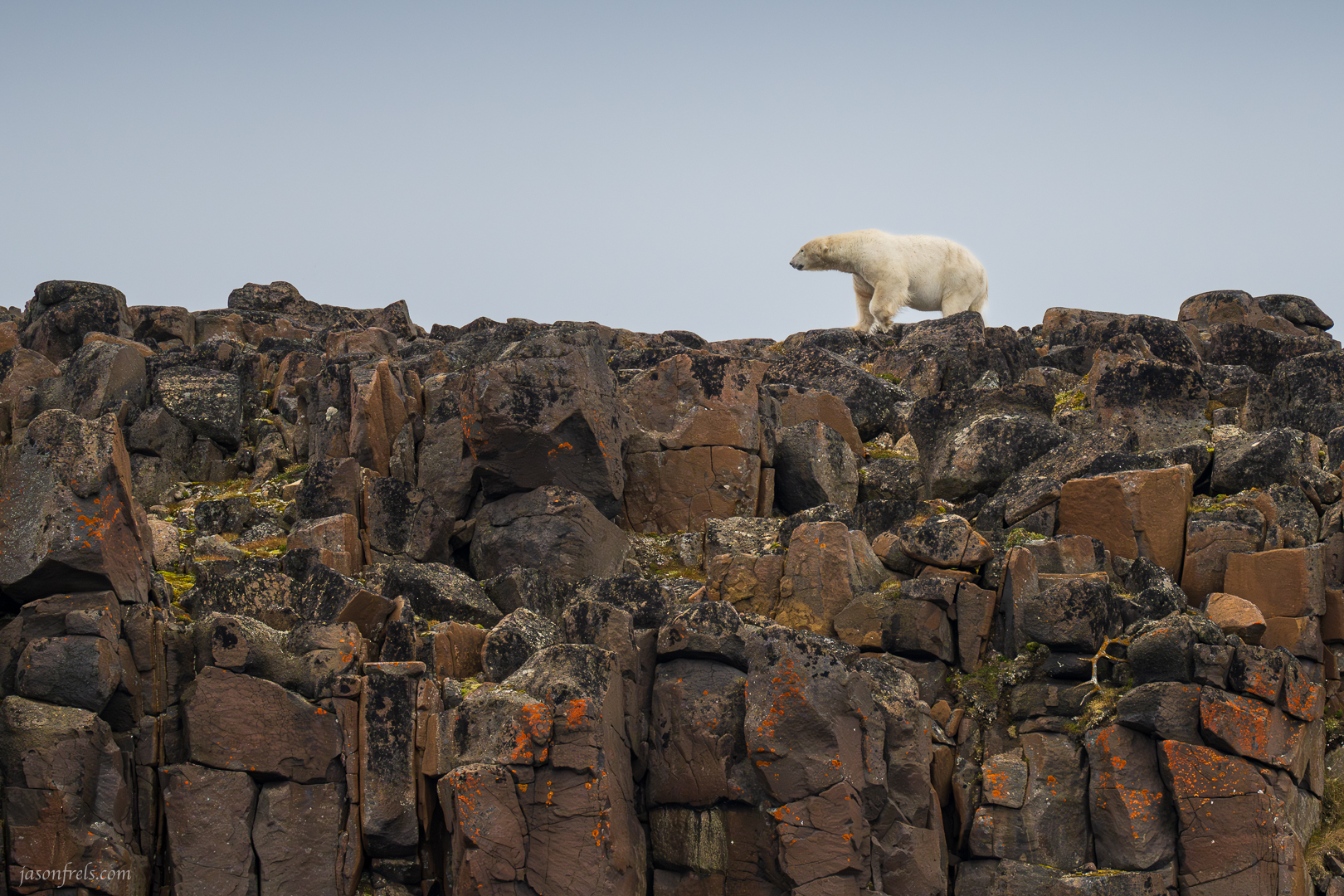
On the third day of the expedition, we found bears on a small rocky island just off the mainland of one of the larger islands. There were two, maybe three polar bears roaming around on this island. We milled around offshore in the zodiacs looking for good places to shoot photos of them. Eventually a large animal carcass, possibly a walrus was seen on the shore and would seem to be what attracted the bears. Polar bears are said to have incredibly good sense of smell and probably detected the carcass from a great distance and then swam to the island to investigate. The bear in the photo above was wandering the island not far from the carcass and stopped to sniff the wind occasionally.
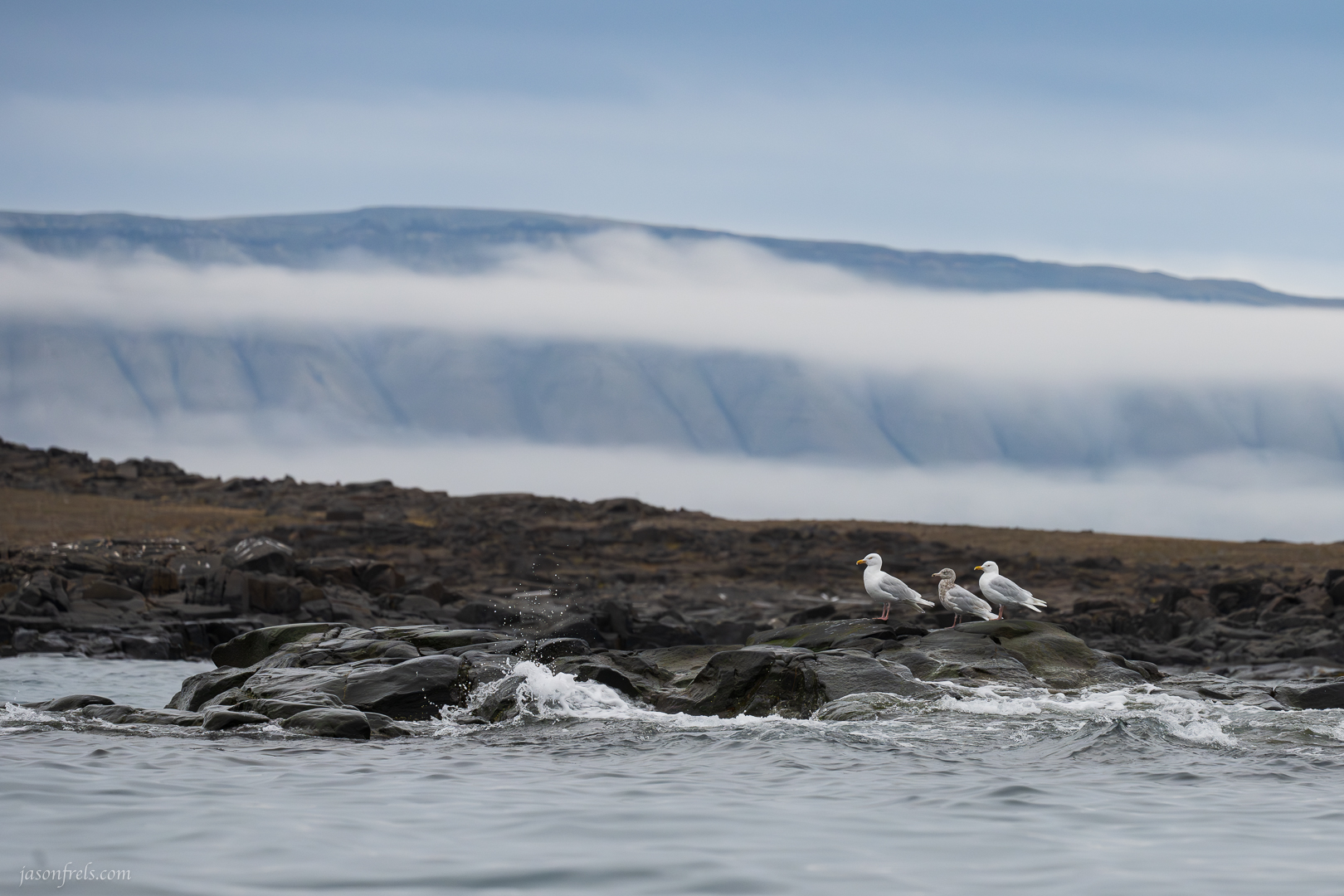
We eventually got to the carcass and waited to see if a bear would show up. The sea birds were already onsite and waiting to see what would happen. The photo below with the sea birds against the shrouded hills in the distance was begging me to take it. I tried to wait for waves to crash on the rocks, but the sea was relatively calm on this morning.
Eventually one of the bears did show up in the area of the carcass. It seemed quite a bit hesitant around the carcass and kept sniffing the air and checking its surroundings. Perhaps it was worried about the other bears and a potential dispute over the food source.

My initial photographic strategy was to use a 2x teleconverter on my 100-400mm lens, but the teleconverter reduces light gathering by 2 full stops and I was getting really noisy photos in the overcast conditions. I removed the teleconverter and decided to shoot at a brighter aperture and crop in post. I have found that my teleconverter is excellent in well-lit conditions, but when the light gets a little dim, the image quality really goes down as the ISO values go way up. So all the images you see here were shot at 400mm and cropped.
The polar bear eventually approached the carcass and carefully began going after it. I have a lot of photos in which the bear is eating the animal but they are all bear butt photos, so I didn’t include them. The bear would attack the carcass for a minute and then pop its head up, look around and sniff the air for a minute. I think it was worried that the other bear would show up.
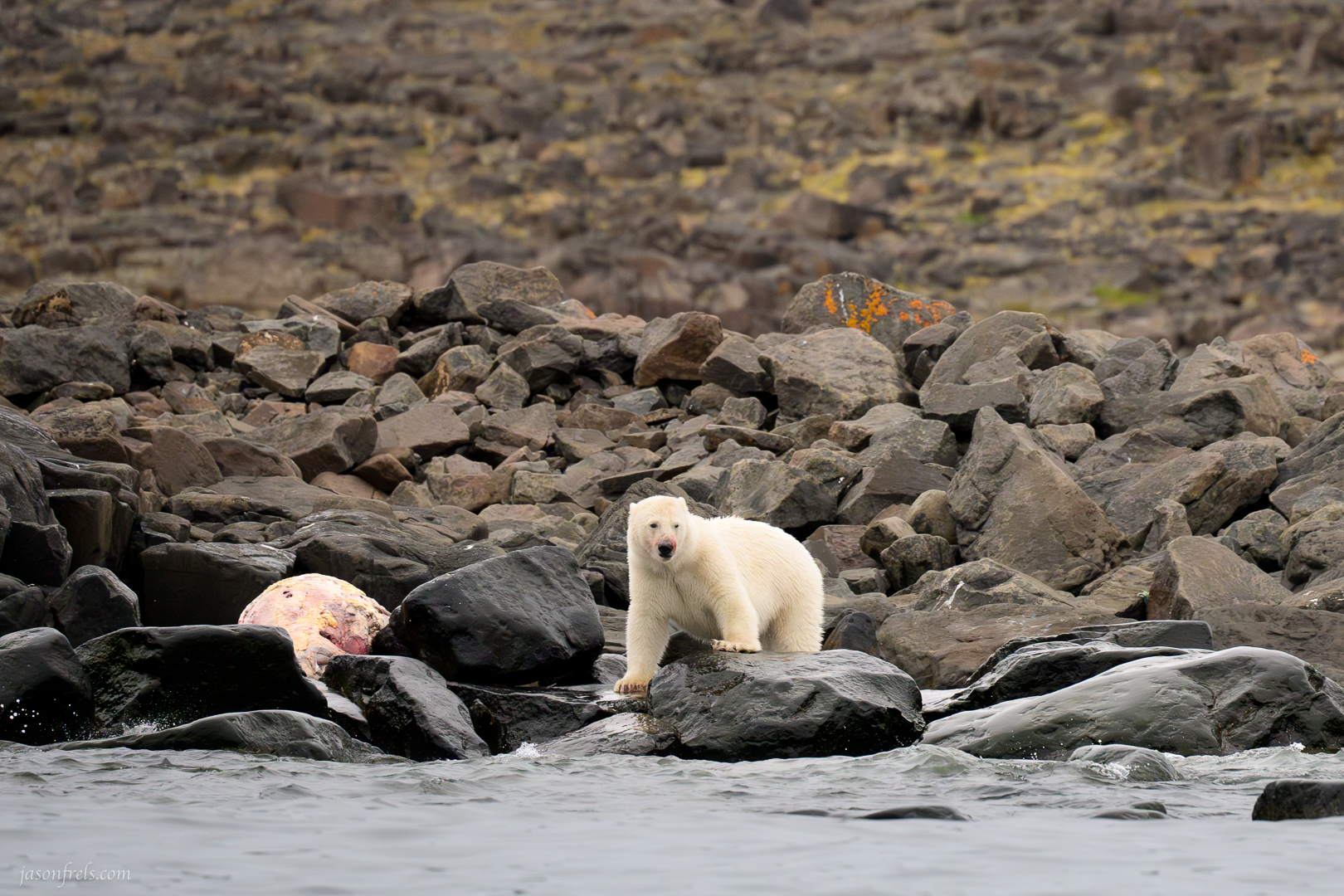
My camera doesn’t have any of the advanced animal auto-focus features on the latest wildlife focused cameras. I was also shooting from a bobbing boat offshore with about 9 other long-lenses right next to me shooting the bear. So my strategy was to use small area auto-focus – continuous servo, try to put the focus point on the bear’s face, do a 3 – 5 shot burst, and repeat. I’d say to 30 – 40 % of my images had focus on the bear. Spray-and-pray seemed to be my best bet for getting good photos in this situation.
I’m sure the bear knew we were just offshore. The boat motors made a powerful exhaust smell and I am sure that the bear could smell that and the people. But the bear seldom even looked our direction as we were apparently just some insignificant part of its environment. The bear seemed far more worried about the other bear than a bunch of clicking cameras in boats.
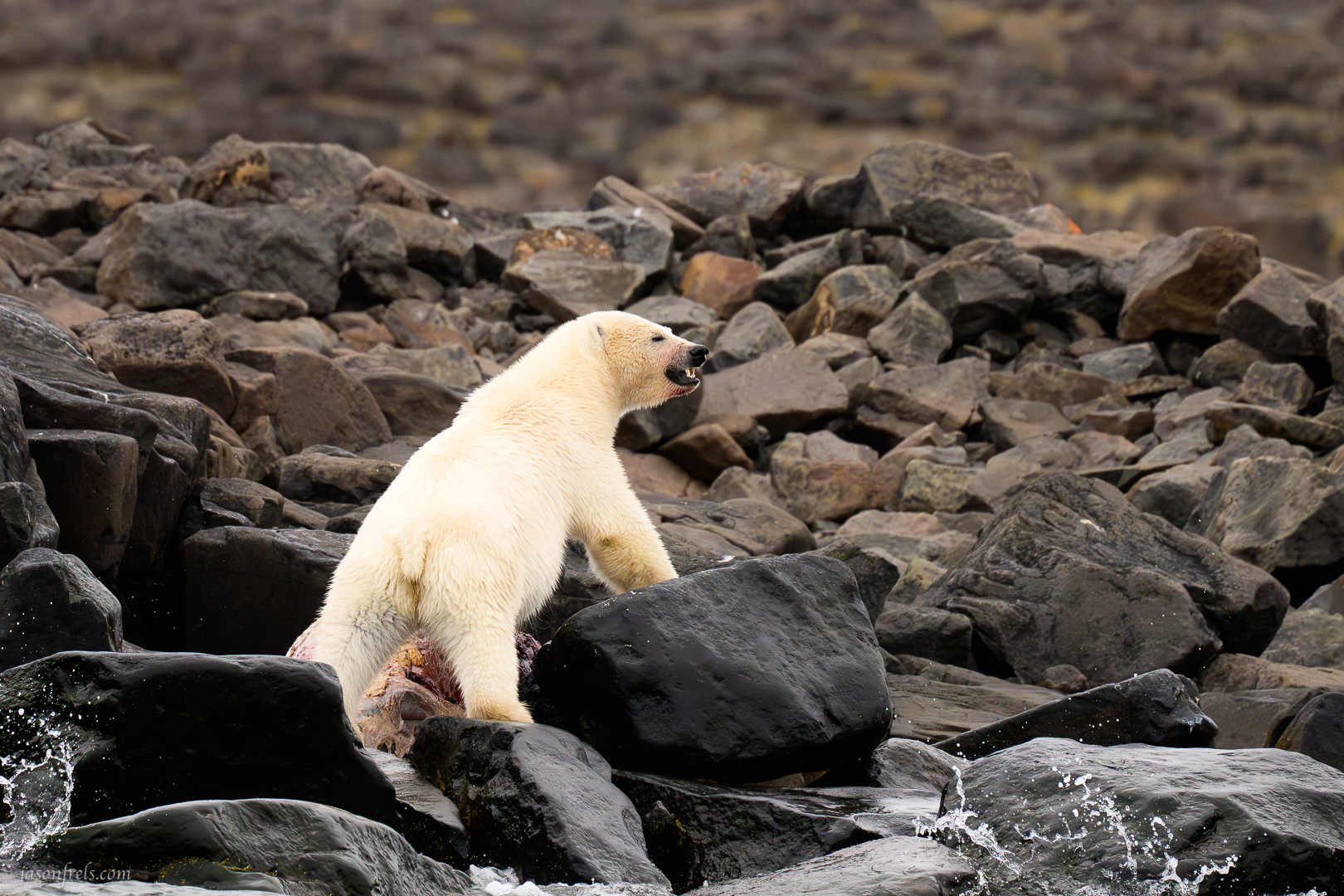
Eventually our time ran out and we had to leave the bear to its meal and return to the ship. I logged 472 photos on this outing, second only to the next major polar bear encounter the next day. Seeing the bears in the wild, relatively up close was a strange experience. I was at once in awe of the moment and focused on getting just a few more photos. A few times I had to just sit there and look at a polar bear across the water, eating on a carcass and appreciate the moment. The world is an amazing place.
Back to the ship. I took the vertical below as there was just so much featureless gray sky above the ship that I thought the negative space would really emphasize the little ship on the sea. I promise that the image below is a full color image; it was just that gray on this day.

Thanks for reading. In the next blog, we go to the bird cliffs where I got my favorite photo of the trip.
 Jason Frels
Great shots, even if you did have to improvise with your camera strategy. And it’s a good thing you were at a safe distance, in a quick-escape motor boat. I’d hate to come across one of those creatures while on foot, as I understand they can be very aggressive. Whoever says humans are at the top of the food chain has never encountered a polar bear.
LikeLiked by 3 people
I didn’t feel like testing out top-of-the-food-chain theory on the bears. I do know that at the lunch buffet back on the ship, I was high on the food chain.
I figured that shooting photos of the bears would require a lot of learning. I didn’t consider how tough it was going to be getting focus while bobbing up and down in a boat. There is no way to stabilize yourself in such a situation, so you just have to bump up the shutter speed, take a lot of bursts and hope you get focus in some of the photos. I also tried to wait until the bear’s face was visible and it looked somewhat interesting.
I did appreciate that in a zodiac full of photographers, we were all considerate of each other and made sure that we all had a good view. Photographers seem to be generally mindful of being in the way of other photographers. I don’t remember ever getting annoyed with anyone. It was a good group of people.
LikeLiked by 2 people
I guess you’d need a pretty fast lens, to deal with the bobbing boat and moving bears.
A visible face does make an animal photo more interesting. Animals seem to have a keen sense for presenting their ass end to a camera, which can be kind of frustrating.
That’s nice that you’ve been traveling with such a considerate group of people.
LikeLiked by 1 person
The faster lens the better, but the fast super telephotos cost more than this trip did. My lens is sort of intermediate, but it did OK.
I think photographers learn how annoying other people are when you are trying to get the photo and become sensitive to their own behavior unless they are jerks. I didn’t meet any jerks on this trip.
LikeLiked by 1 person
Like any hobby, you can spend as much as you have on it. From what I could tell, your “intermediate” lens did great. Your photos look about as professional as anything I’ve seen in a magazine.
LikeLike
The Polar Bear shots are really good!
LikeLiked by 1 person
Thanks
LikeLike
The bear photos are actually quite good, especially considering the conditions. It’s amazing to consider that such a large animal can find sufficient food to survive in such a desolate environment. I suppose that says something about the seas of the arctic regions not evident in that last photo. Drives home both life’s tenacity, and how inhospitable the environment is for a human.
LikeLiked by 1 person
There must be a lot of seals around, though I only saw a couple.
In the polar bear lecture, he said that polar bears begin to overheat if temperatures rise above 10C/50F and are much more comfortable in temps far below freezing. I think they go fatten up in the winter out on the sea ice where they can find seal air holes to stake out. In summer, I think they have a tougher time finding food on land aside from the odd nature photographer.
LikeLiked by 1 person
Answers a question I had about whether or not they go into torpor during the winter. Apparently not, if that’s prime seal-hunting season. Sort of a seasonally-reversed behavioral adaptation to the polar environment. Now I’m wondering if that’s instinctive or learned.
LikeLiked by 1 person
I am no polar bear expert. There were just interesting lectures on the ship. They primarily are specialized to eat seals, because they need the seal blubber. And seals are easier to catch on the sea ice. The sea ice doesn’t extend down to Svalbard in the summer months, so they have a lot of swimming to do.
Adult walruses are a bit too tough and dangerous for polar bears. I think they struggle a bit nutritionally if they have to eat other animals.
The female polar bears create a den when they are pregnant and sleep or whatever. There were islands off-limits to us because they were key polar bear den areas.
There are probably much better sources than me about polar bears out there.
LikeLiked by 1 person
You know more than me. All I’m familiar with are the local bears that will attack trash cans in order to get at the cheese stuck to pizza boxes left by tourists. Can’t imagine anything around here tough enough to eat a seal, let alone a walrus. I suspect a Polar Bear would see a human as little more than a crunchy, late-afternoon snack.
LikeLiked by 1 person
Wow, how very cool. That’s something I’d love to do since zoo sightings don’t really count. Such a fascinating creature.
LikeLiked by 2 people
Awesome polar bear shots. I don’t think I can pick a favorite. It would be quite something to see them in their natural habitat like that. One of those “once in a lifetime moments.”
I also loved the seabirds photo, of course. My friends. 😊
LikeLiked by 1 person
Well, if you don’t get too close, it could be more than once in a lifetime.
If you like sea birds, you might like to see what terns up in the next post.
LikeLiked by 1 person
Haha! I am glad you didn’t get too close. I heard they were the most aggressive bears. I used to think it was grizzlies. I still wouldn’t want to get to close to a grizzly either!
Yes, PUN-derhead I am pretty confident I will enjoy the next post. Seabirds and puffins? 😊
LikeLiked by 1 person
What’s a puffin?
LikeLiked by 1 person
🤦♀️!
Take a close look at your next post, and I bet you will find one.
LikeLike
Crap! I had better up my Photoshop game and see if I can get a puffin in there.
LikeLiked by 1 person
Oh, help, smartie!!
LikeLike
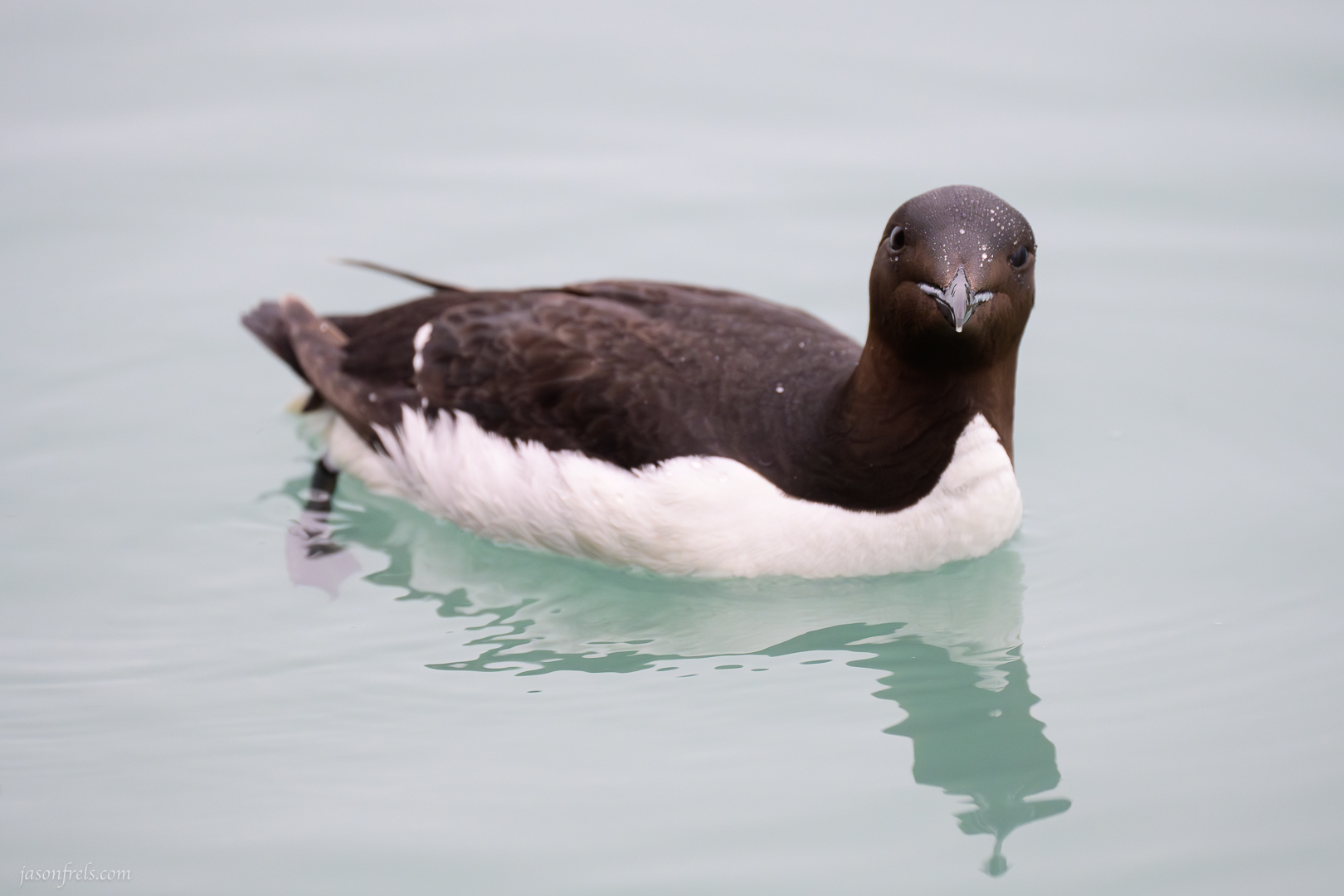
But hey, the Guillemots are considered the penguins of the arctic, so maybe you won’t be too disappointed.
LikeLiked by 1 person
Guillemots??
LikeLiked by 1 person
You will either have to search or wait patiently until I go through about a thousand photos from a bird cliff area.
LikeLiked by 1 person
I will wait ….. patiently, of course….as I tap my fingers on the desk. 🙂
LikeLike
Be patient.
LikeLiked by 1 person
Ahh! So that is a guillemot. I see why they are called penguins of the Arctic. Good photo! Good luck going through your thousands of photos. I am sure they will make a wonderful post.
LikeLiked by 1 person
Thanks. There were tens of thousands of these things at the cliffs. The young were beginning to get old enough to begin the journey south for the winter.
LikeLiked by 1 person
That would be cool to see so many!
LikeLike
Amazing captures, Jason! How wonderful!!!
LikeLiked by 1 person
Thanks. The polar bears made it easy.
LikeLiked by 1 person
Tee hee! I’m so glad they did!
LikeLiked by 1 person
Can’t imagine seeing such a creature like that in the wild, zoo maybe. Simply amazing. So, time for a mega sensor mirrorless camera with a lens adapter for your current lenses? Then cropping would be about the same as what you currently have, plus much better high ISO resolution. Just a thought. Some stores have layaway plans. 🫣🥴😬
LikeLiked by 2 people
I am trying not to purchase more gear. I have good equipment
LikeLike