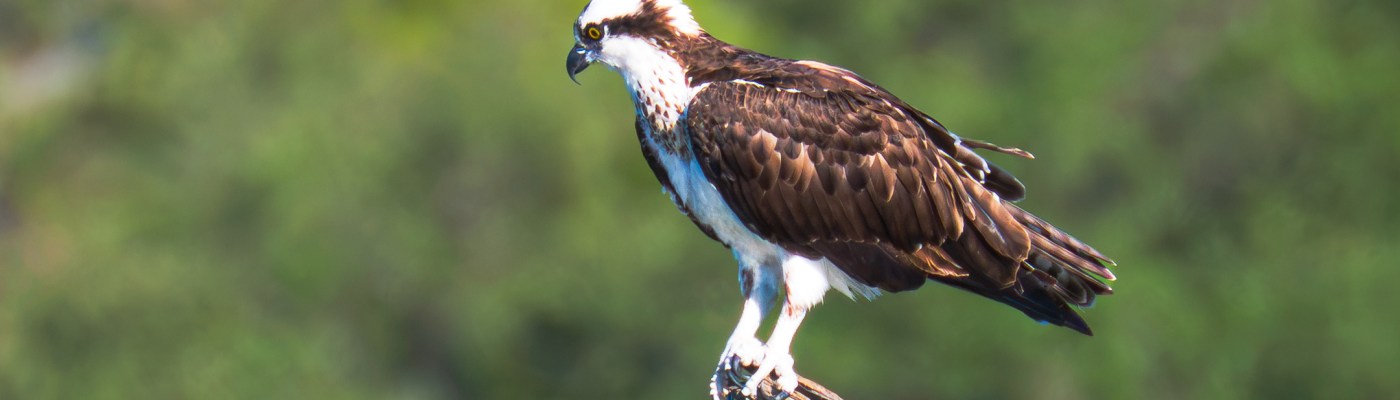
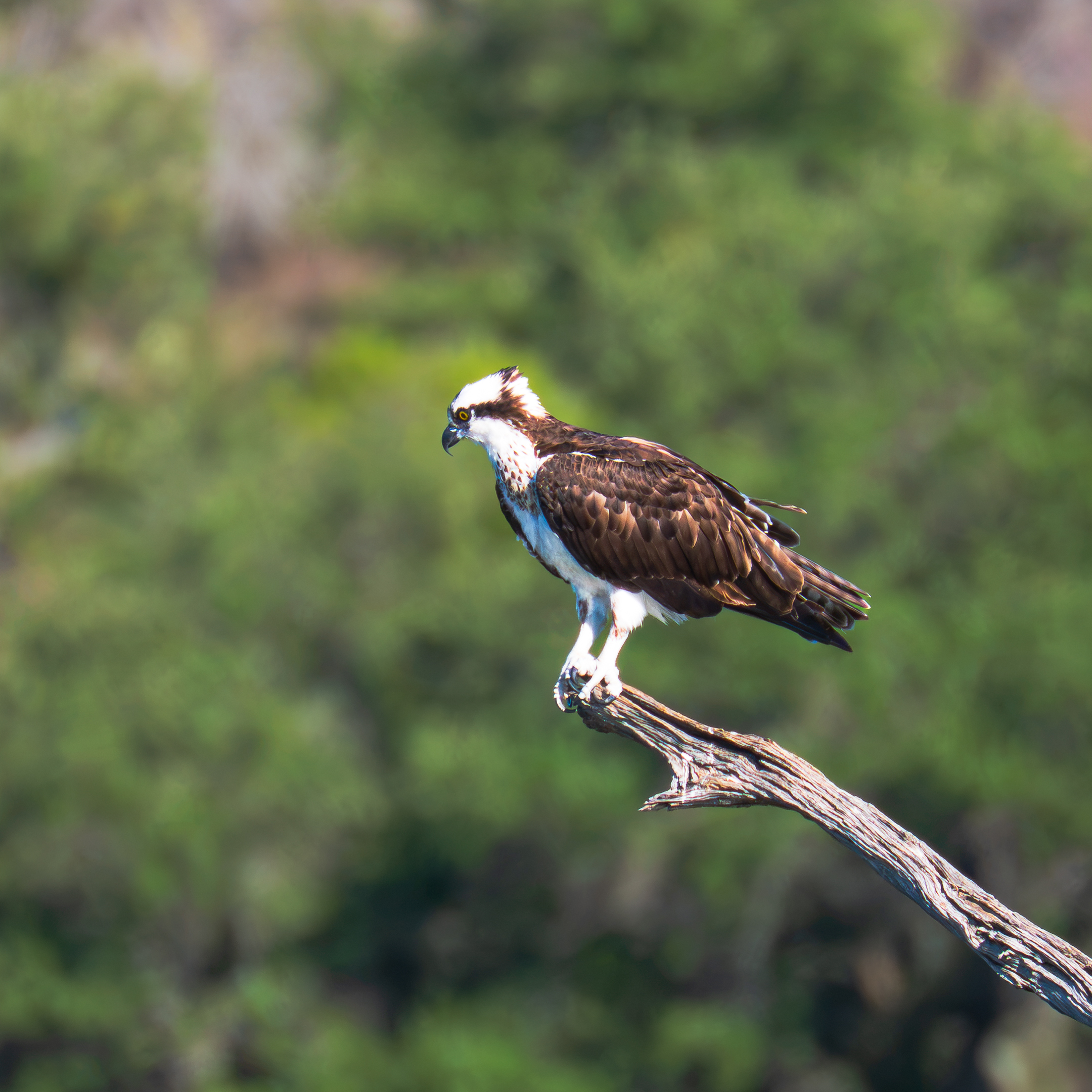
Ospreys are a close relative of hawks and are sometimes called fish-hawks. They almost exclusively hunt and eat fish, rarely being seen very far from a waterway. Many of the sources I have read suggests that they don’t live in central Texas, or that they just migrate through and are mainly in Texas during the winter. But I often see them at the lakes nearby and all the year round. Perhaps there are a few that choose to live here. The photo below shows a perched osprey hanging out at Inks Lake in central Texas in early August. I was driving down the park road (camera with long lens sitting on the passenger seat) and saw it perched on an old dead tree, so I had to pull over and shoot some photos.
According to what I have read, ospreys can be found all over the world, excluding Antarctica, summering up north and wintering down south. They approached extinction in the mid twentieth century due to heavy DDT use working its way through the food-chain, but after that pesticide was banned they made a strong recovery and their conservation status is now Least Concern. By far the largest population of ospreys lives in the Americas where they migrate thousands of miles per year from the US and Canada down to South America.
They like to nest in the tops of dead trees, or these days on utility poles and other human constructs. People often will erect osprey platforms to attract them. The males mainly start by building a rough frame of a nest with large twigs and sticks and then fill it in with grass or seaweed or whatever they can get their talons on. The osprey couples usually return to the same nest for years with both parents helping to raise the chicks. In the photo below, you can see an osprey starting a rough nest on a power pole in central Texas, where they apparently don’t breed.

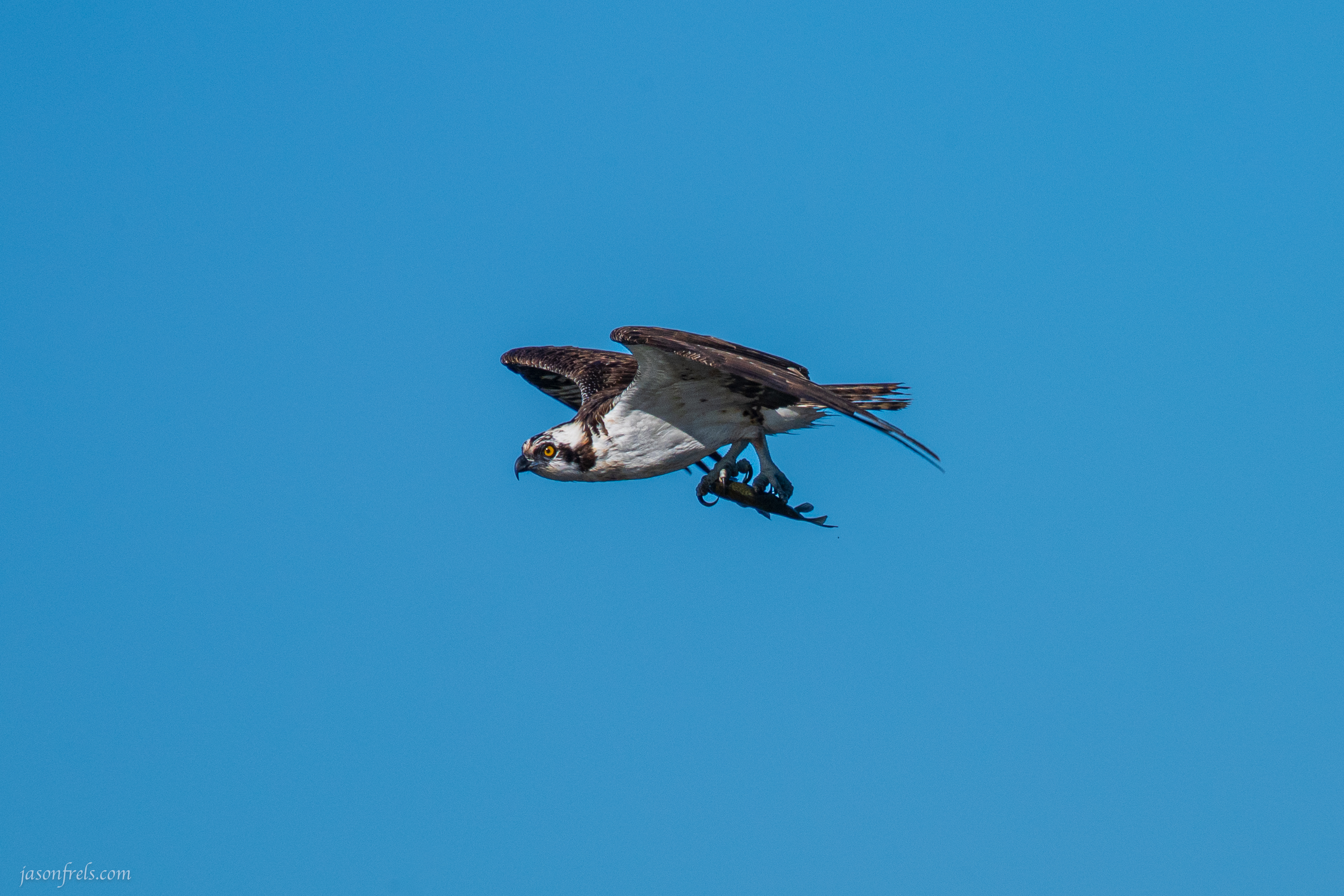
Ospreys are excellent fishers. Once they have identified their target, they can hover over the water and the plunge feet-first at high speed and grab their prey with their adapted talons. Compared to other hawks, ospreys have a special outside toe that rotates around allowing it to get a much better grip on its fish with two claws in the front and two behind. Not sure if you can completely see that in the image below, but you can see that the bird is in no danger of losing its meal with that grip.
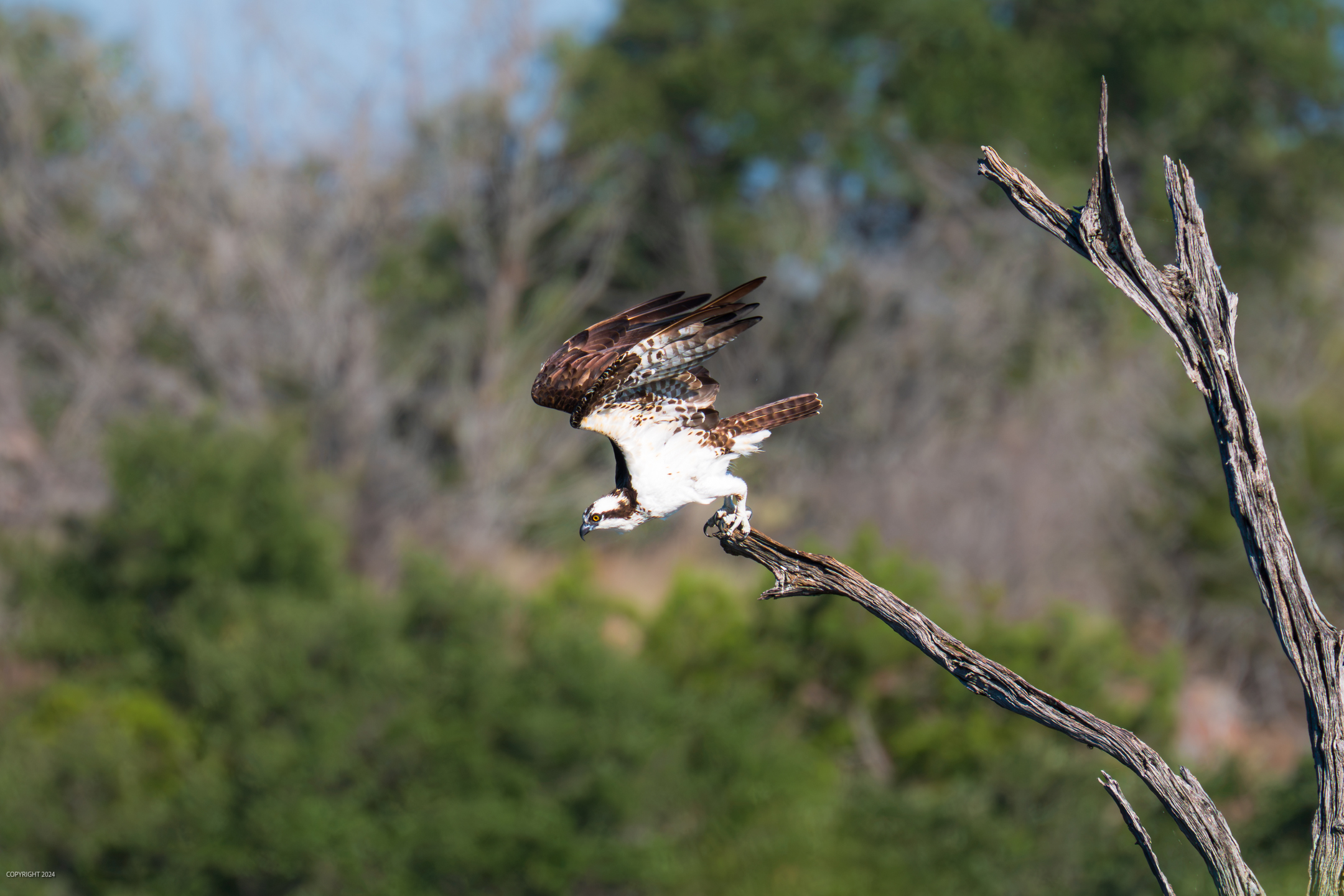
Ospreys are cousins of the hawks, but they are pretty easy to tell apart. The osprey have a dark brown face stripe against the white feathers on their underside and neck. They have brown feathers on top and their wings make a characteristic M-shape when flying. They also have a sharp, hooked beak as many predator birds have. And as you may have noticed, they have massive talons. The image below shows the osprey leaving its perch, perhaps it saw a fish or maybe it wants to get away from some yokel with a long lens pointed at it.
The next image below shows a red-tailed hawk. You can easily see the difference in their heads and the shape of their wings with a quick glance. Both are common around here and I enjoy seeing them.

Sunny summer mornings are a great time to see birds around the lake. The birds are active in the mornings, you get nice side lighting on the underside of their bodies, and there is plenty of light to shoot with a teleconverter. On this morning I was walking around the fish hatchery and driving near the lake with my camera (and coffee thermos) at the ready.
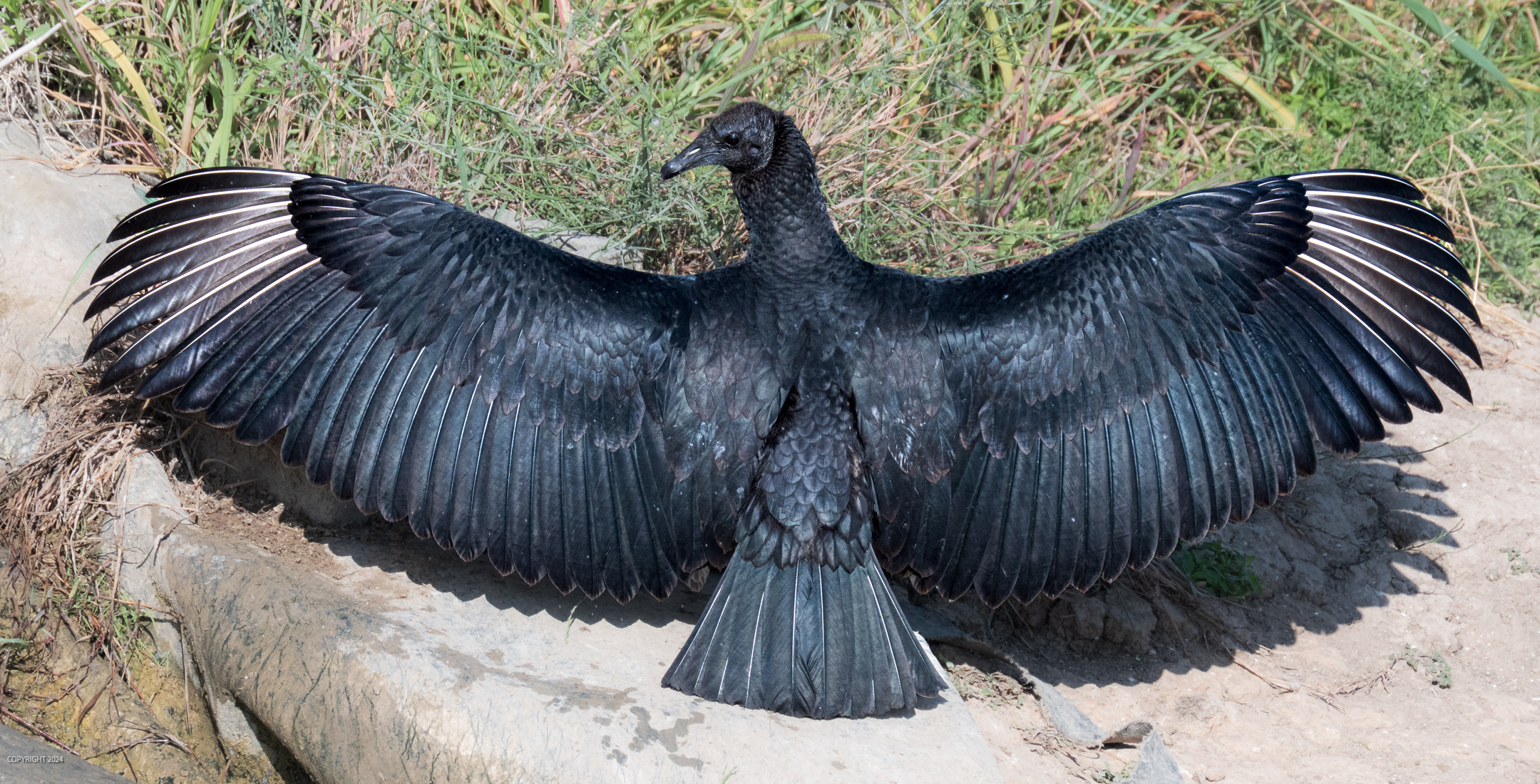
Though it is a little off-topic, I did find this black vulture sunning its wings and thought it made a glorious display. Thanks for reading.


Magnificent 🙌🏼😎😍
LikeLiked by 1 person
Very cool! Locally, ospreys seem most common around the smaller, sub-alpine lakes. Didn’t know about the talons. But watching one snag a fish, a young girl in our group commented that if it was an osprey, it would turn the fish into the wind. Sure enough, just like that third shot.
Second photo is troubling. Power-poles in the valley have large “T” frames on the tops.
LikeLiked by 1 person
That nest doesn’t seem to have lasted long. Maybe the utility company got rid of it.
LikeLiked by 1 person
Hopefully using something other than electricity! 😬
LikeLike
The first photo is my favorite. Love the osprey’s color, and it’s posing so nice for you.
Nesting in the telephone wires is definitely not recommended!
I may not especially like vultures, but your photo of it with its wings outstretched is impressive!
LikeLiked by 1 person
I wish I could get the hawks to pose for me like that
LikeLiked by 1 person
You will have to start speaking their language and ask them nicely. 🙂
LikeLike
In other words, no puns. 😁
LikeLiked by 1 person
Terrific photos. These birds of prey are mesmerizing. I could watch them for hours.
LikeLiked by 1 person
Great shots. I like the one where it’s carrying the fish in-flight.
These are very spiritual birds. Before eating any fish, they will bow their heads and say, “Let osprey.”
LikeLiked by 4 people
Are you checking the sky for any stray lightening bolts that might respond to that comment?
LikeLiked by 3 people
In fact, we have some thunderheads forming outside, right now. I think I’ll stay indoors.
LikeLiked by 3 people
Great information and your photos are gorgeous! I learned a lot from your post.
LikeLiked by 1 person
Thanks. It was fun to research and write to go along with taking photos. Makes me appreciate the animals.
LikeLiked by 2 people
Really nice Jason. Good action.
LikeLiked by 1 person